1 - Disclaimer

This publication is produced by the NATO Mountain Warfare Centre of Excellence (NATO MW COE) and is intended for external use. The information contained in this publication does not represent any official NATO policy or position and is intended to provide an independent analysis and perspective of the NATO MW COE.

The observations presented in this document should not be interpreted as prescriptive solutions applicable to all nations and operational contexts.

National force structures, doctrine, procurement systems, legal frameworks, and operational requirements differ significantly among Allied and Partner nations. Consequently, the findings and recommendations contained herein are intended to support discussion, experimentation, capability development, and further analysis rather than impose specific organizational models.

Similarly, the rapid pace of technological development requires caution. The relevance of individual platforms may change rapidly. However, the broader operational trends identified throughout this report—including the growing importance of persistent surveillance, decentralized effects, Counter-UAS capabilities, electromagnetic resilience, and rapid adaptation—are expected to remain highly relevant for the foreseeable future.

The objective of this report is therefore not to predict the future of unmanned systems, but to contribute to the understanding of how military organizations operating in mountainous environments can adapt to an operational environment in which unmanned systems are already becoming a structural component of the battlefield.

At the end of this document, a Special Insight is provided on a topic that deserves particular attention in Mountain Warfare: “Drones and the Psyche: Conditioning and Consequences for Military Operations.”

2 - Executive Summary

The Unmanned Systems in Mountain Warfare: Company Employment and Battalion Integrationu201d workshop, conducted at the NATO Mountain Warfare Centre of Excellence, examined the rapidly evolving role of unmanned systems in contemporary operations, with a specific focus on their implications for mountain warfare.

The discussions confirmed that unmanned systems are no longer emerging capabilities, but central components of the modern battlefield in Mountain Warfare. Their widespread use has fundamentally altered how forces observe, decide, and act, creating an operational environment characterized by persistent surveillance, rapid targeting cycles, and decentralized execution.

A key finding is the transition from a battlefield defined by intermittent exposure to one of continuous observation. Low air dominance can no longer be taken for granted. Units must now assume that detection is constant and that engagement may follow within minutes. This shift significantly reduces reaction time and places greater emphasis on dispersion, mobility, and signature management as primary means of survivability.

The increasing density of unmanned systems on the battlefield has also fundamentally altered traditional concepts of survivability and maneuver. Concealment and static protection alone are often no longer sufficient in an operational environment characterized by continuous aerial observation and rapid target engagement cycles. Unmanned systems have enabled a decentralization of capability, something that for a Mountain soldier exists since the first day of training. This increases (or renew in technological means) the autonomy of tactical units but also generates a requirement for coordination and integration at battalion and brigade level, where multiple systems must be synchronized within a coherent operational framework.

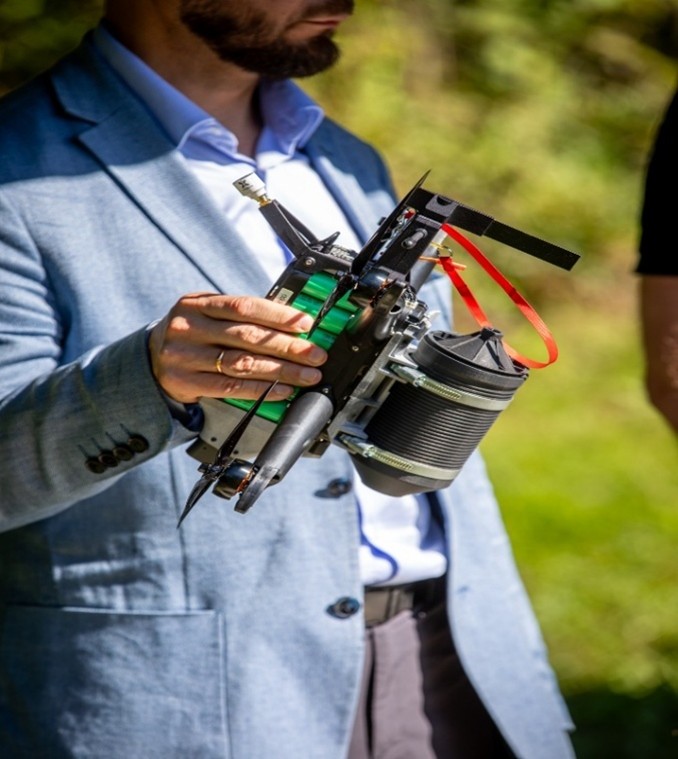
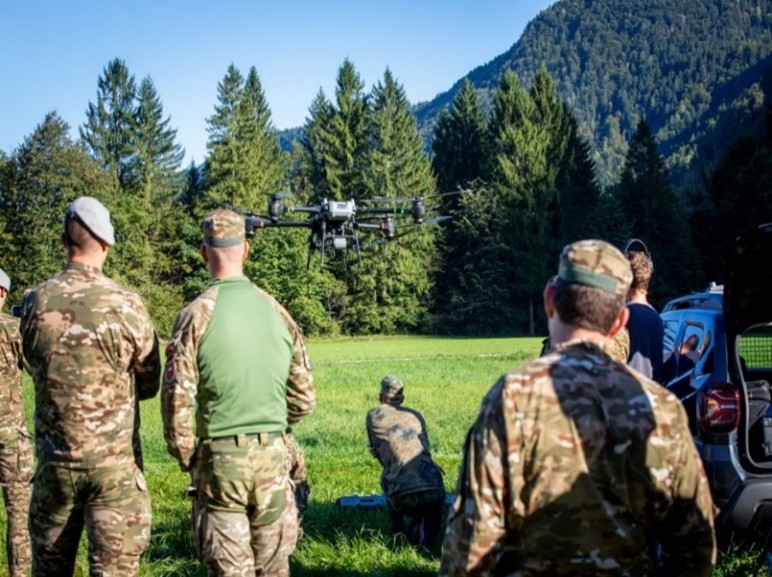
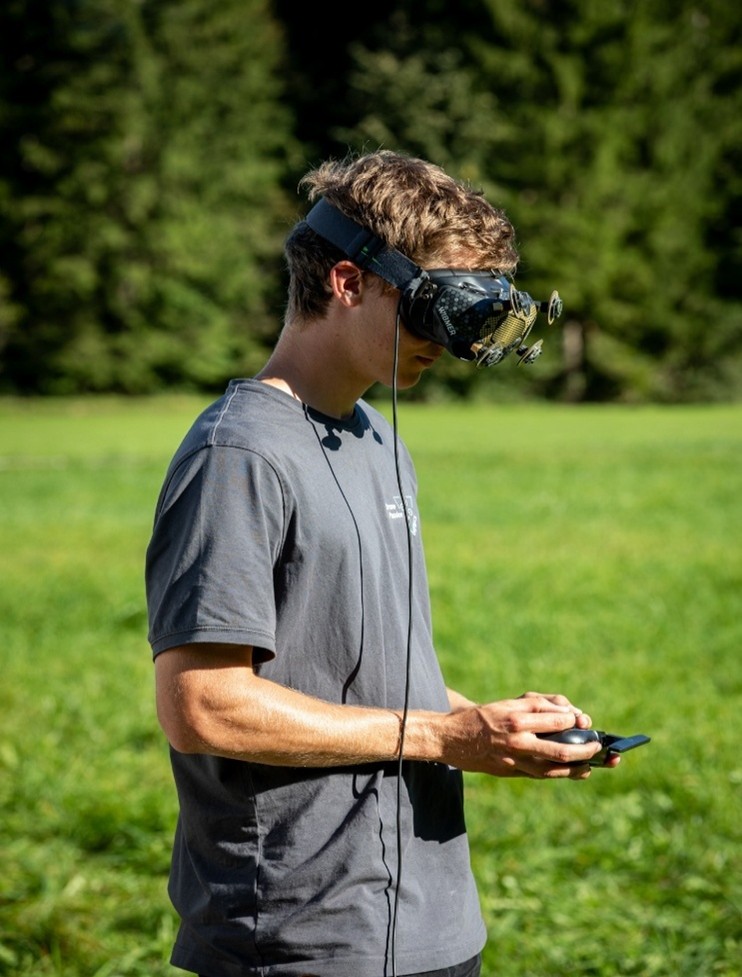
In addition, UAS/UAV and autonomous systems open entirely new operational possibilities in terms of mobility, speed, reconnaissance, command and control, situational awareness, terrain analysis (snowpack, avalance etcu2026) and tactical effectiveness. ISR drones allow persistent observation of terrain features and movement corridors which are difficult or impossible to observe from the ground. FPV systems provide decentralized strike capabilities at lower tactical levels, while cargo drones and autonomous support systems improve sustainment and logistical flexibility in isolated or hard-to-reach areas.

The workshop also highlighted a critical mismatch between operational adaptation and institutional processes. While battlefield innovation occurs rapidly, driven by continuous experimentation and feedback, doctrine, training, and procurement systems evolve more slowly. Bridging this gap is essential to ensure that available capabilities are effectively employed.
Another central finding concerns the electromagnetic environment, which must now be considered contested and degraded by default. GNSS denial, communications disruption, and electronic warfare are persistent features of the battlefield. Systems and procedures must therefore be designed to operate under these conditions, rather than relying on their availability.

Counter-UAS emerges as a fundamental requirement for survivability. It cannot be treated as a specialized capability, but must be integrated across all levels of the force, combining behavioural adaptation, awareness, and technical solutions within a layered approach.

The lessons identified further highlight that future operational success in mountainous terrain will increasingly depend on the ability to effectively integrate unmanned and autonomous systems into all aspects of military operations, including the Military Decision-Making Process (MDMP), Mountain Cell procedures, reconnaissance planning, sustainment operations, and Counter-UAS concepts an TTPs.

The workshops done in the NATO MW COE and all the studies conducted leads to a clear conclusion: the challenge is not to introduce unmanned systems into existing structures and training, but to adapt those structures to a battlefield in which unmanned systems are already central. Based on these findings, several priority areas for adaptation emerge in the discussion during the workshop:

  • Doctrine must evolve to quick integrate unmanned systems across all warfighting functions and reflect decentralized execution.
  • Training must systematically expose units to drone-enabled and degraded environments, including GNSS-denied conditions.
  • Force structures must align capabilities with operational needs, embedding UAS at company level and ensuring coordination at battalion level and above.
  • Procurement models must become more flexible and responsive, enabling rapid adaptation and bottom-up innovation.
  • Electromagnetic resilience and low airspace management must be treated as core operational functions.

The workshop represents a step within a broader effort to translate operational experience into doctrine, training, and capability development. The MWCOE will continue to support this process, contributing to the evolution of NATO standards, including ATrainP-6, and fostering a shared understanding across Allied nations.

3 - Operational Context and Purpose

Recent conflicts, most notably in Ukraine, have demonstrated that drones are no longer confined to specialized roles. They are employed across all levels, providing persistent surveillance, enabling rapid targeting, and supporting both decentralized and massed effects.

At the same time, these trends have exposed a growing gap between operational practice and doctrinal frameworks. While existing NATO publications, including ATrainP-6, provide a solid foundation for mountain warfare, they reflect a context in which unmanned systems are integrated as supporting capabilities rather than as central elements shaping the battlefield.

This gap is particularly relevant in mountain environments. Terrain imposes constraints that amplify the impact of unmanned systems. Movement is channelized, lines of sight are fragmented, and concealment is increasingly difficult under persistent aerial observation. At the same time, communications and navigation are degraded, complicating coordination and increasing dependence on resilient systems and procedures.

In this context, the integration of unmanned systems is not simply an opportunity to enhance capability. It is a requirement to maintain operational effectiveness.

The purpose of the workshop was therefore to move beyond a general understanding of the technology and address its practical implications at tactical level, with a specific focus on company and battalion operations.

In particular, the workshop aimed to:

  • examine how unmanned systems are currently employed in operational environments
  • identify gaps in doctrine, training, and force structure
  • explore solutions for integration, coordination, and survivability
  • and contribute to the ongoing development of Tactical Techniques and Procedures relevant to mountain warfare

The workshop also forms part of a broader effort led by the MWCOE to support the evolution of NATO doctrine and training. Its outputs are intended to inform future work, including the refinement of ATrainP-6, ATP 3.2.1.3, the MW Concept and the development of complementary studies addressing unmanned and autonomous systems in mountain operations.

Ultimately, the activity was designed not only to analyse the problem, but to initiate a process of adaptation, linking operational experience to doctrinal development and practical implementation.

4 - Methodology and Framework

4.1 – Analytical Approach

This report is based on a continuous process of observation, experimentation, assessment, and knowledge development conducted by the NATO Mountain Warfare Centre of Excellence (MWCOE) between 2024 and 2026. Rather than relying on a single study or isolated activity, the findings presented herein originate from the cumulative results of workshops, experimentation campaigns, pilot projects, demonstrations, training activities, operational observations, multinational exchanges, and expert discussions involving military personnel, subject matter experts, industry representatives, and partner nations.

The methodological approach adopted throughout this work reflects the understanding that unmanned and autonomous systems cannot be adequately assessed through technical performance alone. Their true operational value for Mountain Warfare emerges only when examined within the broader context of military operations, organizational structures, command and control arrangements, force protection requirements, sustainment processes, and environmental constraints.

For this reason, the analysis intentionally focuses on operational relevance rather than technological specifications. The central question is not whether a particular platform performs effectively under ideal conditions, but how unmanned systems influence decision-making, survivability, maneuver, sustainment, reconnaissance, and combat effectiveness within realistic mountain warfare environments.

4.2 – Sources of Analysis

The observations and conclusions contained in this report are derived from multiple complementary sources.

The first source consists of practical activities conducted by the MWCOE, including workshops, field experimentation, demonstrations, training events, and pilot projects involving ISR drones, FPV systems, cargo drones, autonomous support systems, and Counter-UAS capabilities.

The second source derives from operational observations and lessons identified from contemporary conflicts, particularly the ongoing war in Ukraine. These observations provide a unique opportunity to examine unmanned systems under conditions of large-scale combat operations, persistent electronic warfare, contested airspace, and continuous adaptation cycles. Particular attention has been given to publicly available lessons identified, operational reports, NATO analyses, and observations emerging from NATO-Ukraine cooperation initiatives.

The third source consists of exchanges with military practitioners, operational commanders, instructors, subject matter experts, industry representatives, and partner nations. These contributions provide additional perspectives regarding technological developments, organizational challenges, capability gaps, and emerging trends.

The combination of these sources allows the report to balance practical experimentation, operational evidence, and expert assessment, reducing the limitations associated with any individual source of information.

4.3 – Operational Rather Than Technical Perspective

The purpose of this report is not to provide a technical catalogue of unmanned systems. Technologies evolve rapidly and individual platforms may become obsolete within relatively short periods. The observations presented here therefore focus on operational functions, organizational and Force Structure implications, employment concepts, and recurring lessons that remain relevant regardless of future technological developments.

Throughout the report, particular attention is given to the employment and the reflection on Force Structure, training and procurement of:

  • ISR drones
  • FPV systems
  • Cargo UAS
  • Relay Drones
  • Counter-UAS capabilities
  • Low airspace management
  • Electromagnetic resilience
  • Organizational integration of unmanned capabilities

These areas were selected because they repeatedly emerged as critical themes across MWCOE activities and operational observations from contemporary conflicts.

4.4 – Mountain Warfare Perspective and New Operational Possibilities

While many observations contained in this report are relevant to military operations in general, the analytical framework remains deliberately focused on mountain warfare.

Mountain environments introduce operational conditions that significantly influence the employment of unmanned systems. Restricted mobility corridors, fragmented lines of sight, degraded communications, complex terrain masking, severe weather conditions, altitude effects, and limited sustainment options create challenges that differ substantially from those encountered in other operational environments.

At the same time, these characteristics create not only challenges, but also entirely new operational possibilities.

Traditionally, mountain warfare has been characterized by limited observation, difficult mobility, restricted logistics, and a high dependence on terrain. The introduction of unmanned and autonomous systems is progressively changing these conditions. Rather than simply compensating for environmental constraints, these capabilities increasingly enable activities that were previously difficult, risky, resource-intensive, or in some cases operationally impossible.

ISR systems can extend observation far beyond line-of-sight limitations imposed by terrain, providing commanders with levels of situational awareness that were previously unattainable. FPV systems allow small tactical units to generate decentralized effects at ranges and locations where traditional fires may be unavailable, delayed, or constrained by terrain. Cargo drones create new opportunities for sustainment by supporting isolated positions, reducing exposure along vulnerable supply routes, and increasing operational endurance in remote areas. Autonomous ground systems can further reduce logistical burdens, enhance operational flexibility, and support distributed operations across complex terrain.

These developments do not simply improve existing capabilities. They fundamentally expand the range of options available to commanders.

At the same time, Counter-UAS capabilities become increasingly important. As unmanned systems generate new opportunities, they also create new vulnerabilities. The ability to detect, disrupt, and defeat adversary unmanned systems therefore becomes a critical prerequisite for maintaining freedom of maneuver and operational effectiveness.

For these reasons, mountain warfare should not be viewed simply as another environment in which unmanned systems can be employed. Rather, it represents an operational context in which both the opportunities and vulnerabilities associated with unmanned systems become more visible, more consequential, and more operationally decisive. The mountain environment therefore serves not only as a challenge for unmanned systems, but also as a catalyst for the development of new concepts, new capabilities, and new ways of conducting military operations.

4.5 – Lessons Identified and Lessons Learned

A fundamental assumption underlying this report is that operational observations only become valuable when translated into institutional adaptation.

Recent conflicts have repeatedly demonstrated that the decisive advantage is often not derived from possessing superior technology, but from the ability to learn and adapt more rapidly than an opponent.

Consequently, the purpose of this report extends beyond the identification of lessons. It seeks to contribute to the process through which observations are transformed into doctrine, training, organizational adaptation, capability development, experimentation priorities, and future force design considerations.

In this regard, the report should be understood as part of a broader NATO effort to strengthen institutional learning and to support the continuous evolution of Mountain Warfare capabilities in an operational environment increasingly shaped by unmanned systems, contested electromagnetic conditions, persistent observation, and accelerated adaptation cycles.

5 - Aim of the Document

5.1 – Addressing the impact of Drones on modern warfare

The purpose of this document is not simply to describe the growing role of unmanned systems on the battlefield, but to support the adaptation of mountain warfare forces to an operational environment increasingly shaped by persistent observation, contested electromagnetic conditions, decentralized capabilities, and rapid technological change where unmanned and autonomous systems are no longer peripheral enablers but essential components of the modern battlespace.

For mountain warfare forces, the challenge is no longer the availability of technology, but its integration into doctrine, training, force structures, command and control, sustainment, force protection, and tactical decision-making.

This document seeks to bridge the gap between technological capability and operational employment by identifying lessons learned, highlighting emerging trends, and examining the implications of integrating unmanned and autonomous systems within mountain warfare formations.

More broadly, it contributes to the ongoing process of adaptation and institutional learning across NATO and Allied forces. Rather than providing definitive answers, it aims to inform experimentation, support doctrinal development, stimulate professional discussion, and help mountain warfare forces remain operationally relevant in an increasingly unmanned battlespace.

5.2 Why Ahead: Lessons from NATO-Ukraine Cooperation in Drone-centred Warfare

Over the last years, the war in Ukraine has generated an unprecedented volume of operational data concerning the employment of unmanned systems, electronic warfare, distributed reconnaissance-strike complexes, autonomous technologies, and counter-drone capabilities. Unlike theoretical assessments or technology forecasts, these observations derive from continuous large-scale combat operations involving both state actors and highly adaptive military organizations.

To capture and analyse these lessons, NATO and Ukraine established the Joint Analysis, Training and Education Centre (JATEC), whose mission is to transform operational observations into recommendations for doctrine development, capability development, training, and force adaptation. The conclusions emerging from JATEC are particularly significant because they are not based on isolated incidents or technological demonstrations, but on thousands of operational engagements observed across multiple domains of warfare.

A central conclusion emerging from JATEC is that drone warfare has evolved from a supporting capability into a decisive factor of contemporary conflict. Unmanned systems are no longer limited to reconnaissance functions or niche applications. They are increasingly employed as integral components of intelligence collection, target acquisition, precision engagement, electronic warfare support, force protection, and operational decision-making.

This transformation has profound implications.

Historically, military organizations have often regarded new technologies as capabilities to be integrated into existing structures and procedures. The observations collected by JATEC suggest a different reality. The challenge is no longer how to integrate drones into current operational concepts. The challenge is how to adapt operational concepts, organizational structures, training systems, and force employment models to a battlefield in which unmanned systems are already ubiquitous.

Operational evidence repeatedly demonstrates that relatively inexpensive drone systems can generate effects against platforms whose acquisition and sustainment costs are several orders of magnitude higher. Commercially adapted FPV systems costing hundreds or thousands of dollars have successfully engaged armoured vehicles, artillery systems, command posts, logistics nodes, and force concentrations. This emerging cost asymmetry challenges many of the assumptions that have traditionally guided capability development and force modernization.

Equally important is the impact on operational tempo.

One of the most significant observations emerging from contemporary conflicts is the compression of the decision-action cycle. Persistent aerial surveillance, real-time target acquisition, digital information sharing, and decentralized strike capabilities have dramatically reduced the time between detection and engagement. Activities that previously required multiple command layers and extensive coordination can now be conducted by small tactical units operating organic unmanned systems.

As a consequence, survivability is increasingly determined not by physical protection alone but by the ability to avoid detection in the first place.

JATEC observations consistently highlight that concealment, dispersion, deception, camouflage, mobility, electromagnetic discipline, and signature management have become fundamental elements of force protection. Units that fail to adapt to conditions of persistent observation risk becoming vulnerable regardless of the level of protection provided by traditional defensive measures.

The lessons emerging from Ukraine also highlight another critical challenge: the growing divergence between the speed of battlefield adaptation and the speed of institutional adaptation.

Combat units continuously modify procedures, tactics, technical solutions, and organizational arrangements in response to evolving threats. New employment concepts can be developed, tested, validated, and disseminated within weeks. In contrast, doctrine development, procurement cycles, training programs, force structure adaptation, and capability planning frequently operate on timelines measured in years.

JATEC repeatedly identifies this discrepancy as one of the most important strategic challenges facing modern military organizations.

The decisive advantage is increasingly not the possession of superior technology alone, but the ability to absorb lessons, adapt rapidly, and institutionalize change before adversaries do.

The report further emphasizes that future conflicts must assume contested electromagnetic conditions as the norm rather than the exception. GNSS denial, communications disruption, datalink jamming, spoofing, cyber vulnerabilities, and electronic warfare effects are no longer isolated battlefield phenomena. They have become persistent operational realities.

Particularly noteworthy is JATEC’s recommendation that NATO should assume GNSS denial as a baseline operational and training condition. Such an assessment represents a significant conceptual shift. For decades, military systems have been developed under the assumption that satellite navigation and reliable communications would be available throughout operations. Current operational experience demonstrates that these assumptions can no longer be taken for granted.

Similarly, the saturation of the lower airspace has emerged as a defining characteristic of modern warfare. ISR drones, FPV systems, loitering munitions, relay platforms, electronic warfare assets, cargo drones, and Counter-UAS systems increasingly operate simultaneously within the same battlespace. Managing this environment has become an operational requirement directly linked to mission effectiveness, force protection, and command and control.

Mountain environments amplify many of the dynamics observed in contemporary conflicts.

The observations emerging from JATEC therefore reinforce a broader conclusion that extends beyond the employment of drones themselves.

The future battlefield will not be defined solely by technological superiority. It will be defined by the ability of military organizations to adapt faster than the operational environment changes around them.

This report should therefore be read not merely as a study on unmanned systems in mountain warfare, but as a contribution to a wider process of institutional adaptation. The purpose is not only to examine how unmanned systems can be employed more effectively, but also to support the development of organizations, procedures, training systems, and operational concepts capable of remaining relevant in an environment increasingly characterized by persistent observation, contested electromagnetic conditions, decentralized capabilities, rapid innovation cycles, and continuous adaptation.

The lessons emerging from JATEC make one conclusion unmistakably clear: adaptation is no longer a matter of competitive advantage. It is becoming a prerequisite for operational relevance.

6 - WORKSHOP DAY 1

6.1 – Drone Warfare as a Decisive Factor, an introduction overview

Drone warfare has moved beyond the status of an enabling capability and must now be understood as a structural component of the battlefield. This is not a projection of future trends, but a reality already observable in ongoing conflicts, where unmanned systems are employed continuously across all echelons, shaping how operations are conducted.

As said, the most immediate effect of this transformation is the emergence of a condition of persistent observation. Units can no longer assume that concealment will provide reliable protection, nor that exposure will be temporary. Instead, they operate in an environment where detection is increasingly likely and, once achieved, can be rapidly translated into engagement. The time previously available between being identified and being targeted has been drastically reduced, often to the point of being operationally irrelevant.

This phenomenon is directly linked to the growing density of unmanned systems across the battlefield. Density should not be understood merely as an increase in the number of drones operating in a given area. Rather, it describes the cumulative presence of multiple ISR platforms, FPV systems, loitering munitions, communication relays, autonomous sensors, electronic warfare assets, and Counter-UAS systems functioning simultaneously within the same operational space.

The significance of density lies in its cumulative effect. While a single platform may provide only temporary observation, a dense network of airborne sensors creates a condition in which observation becomes persistent rather than episodic. Detection is no longer dependent upon a specific platform being present at a specific moment. Instead, overlapping layers of sensors continuously monitor the battlespace, reducing observation gaps and increasing the probability that movement, emissions, or operational activity will be identified.

We can state that “low air dominance is no longer our”.

This shift fundamentally alters the logic of survivability. Protection is no longer primarily achieved through armour or fortification, but through the ability to avoid detection, reduce signature, and maintain mobility. In this context, the most significant vulnerability is not the platform itself, but the set of signatures it emits—visual, thermal, and electromagnetic.

At the same time, the widespread availability of low-cost unmanned systems has introduced a profound change in the economic logic of warfare. The ability to generate effects using relatively inexpensive and expendable platforms has created a form of cost asymmetry that challenges traditional assumptions. As a result, the decisive factor is no longer technological sophistication alone, but the capacity to generate mass, persistence, and rapid adaptation.

This dynamic directly contributes to the decentralization of air firepower. Capabilities that were once concentrated at higher levels of command are now available at company level. Small units are increasingly able to conduct reconnaissance, identify targets, and generate effects independently. This compresses decision-making cycles and shifts responsibility downward, placing greater demands on tactical commanders while simultaneously increasing their operational autonomy.

However, this increased availability of capability does not automatically translate into effectiveness. A critical issue highlighted by operational experience is the speed of adaptation. The ability to modify tactics, integrate new tools, and respond to adversary actions in short timeframes has become a decisive advantage. In environments where change occurs rapidly, institutional processes that operate on longer cycles risk becoming disconnected from operational reality. The challenge is therefore not only to acquire capabilities, but to adapt their use at the pace required by the battlefield.

Another defining characteristic of the current environment is the condition of the electromagnetic spectrum. Reliable communications and GNSS availability can no longer be assumed. Instead, degradation, disruption, and denial must be treated as baseline conditions. This reinforces the need for resilience, redundancy, and procedural adaptation.

These dynamics are further compounded by the saturation of the lower airspace. The space between ground level and a few hundred meters above it has become densely populated by a variety of systems, including ISR drones, FPV platforms, loitering munitions, and counter-UAS assets. This creates a highly dynamic environment in which multiple actors operate simultaneously, often without a shared understanding of the overall situation.

Operational experience from recent conflicts suggests that density itself has become a defining characteristic of contemporary warfare. Effects are generated not only by the capabilities of individual systems, but by the ability to employ multiple interconnected systems simultaneously. Density increases persistence, expands situational awareness, accelerates targeting cycles, complicates adversary decision-making, and places unprecedented demands on coordination and airspace management.

Consequently, the lower airspace should no longer be viewed as a secondary operational layer. It is progressively becoming a contested and highly dynamic domain whose management directly influences operational effectiveness, survivability, and freedom of maneuver.

In mountain warfare, the impact of this saturation is particularly pronounced. Terrain restricts movement, limits lines of sight, and channels both ground and air activity into predictable corridors. As a result, units are more exposed to observation and more vulnerable to targeting, while their ability to maneuver and conceal themselves is reduced. The environment amplifies all the effects associated with drone warfare, making adaptation not only necessary, but urgent.

Taken together, these elements point to a fundamental transformation. The battlefield is no longer characterized by intermittent observation, centralized fires, and relatively stable conditions. It is defined by continuous surveillance, distributed effects, contested spectrum, and rapid adaptation cycles.

In conclusion, drone warfare does not represent an incremental evolution of existing capabilities. It represents a change in the nature of operations.

The central issue is no longer whether unmanned systems should be integrated, but how forces must reorganize to operate effectively in an environment where:

  • detection is persistent
  • engagement is rapid
  • mass is decisive
  • and adaptation is continuous

For mountain warfare forces, this transformation is even more significant. If drones continue to be treated as secondary or supporting capabilities, the risk is not simply reduced effectiveness, but structural obsolescence.

However, recognizing the scale of the transformation is only the first step. The next question is whether this reality has already been reflected in our own institutional learning process.

For the MWCOE, this workshop is not an isolated initiative. It is part of a longer path of experimentation, reflection, and gradual adaptation. The following section therefore steps back from the battlefield itself and examines how previous MWCOE activities have approached unmanned systems, what has already been achieved, and where the gap between experimentation and real integration still remains.

6.2 - From Experimentation to Integration: Lessons from Previous MWCOE UAS Activities

The current workshop did not represent a starting point, but rather a transition within an ongoing process. Over the past years, the MWCOE has progressively explored the role of unmanned systems in mountain warfare through a series of workshops, experimentation activities, and initial training initiatives.

These efforts have provided a valuable foundation, not in terms of specific technologies, but in terms of understanding how unmanned capabilities interact with the operational environment. From the outset, the focus has not been on platforms, but on their employment, integration, and relevance within mountain operations.

The trajectory of this work shows a clear evolution. Initial activities were primarily exploratory, aimed at assessing the potential of UAS in supporting specific functions such as environmental monitoring, reconnaissance, logistic and search and rescue. These early use cases demonstrated flexibility and utility, but remained largely confined to functional applications, disconnected from a broader operational framework.

Over time, this approach proved insufficient. The increasing relevance of unmanned systems in contemporary conflicts made it clear that their value does not lie in isolated tasks, but in their ability to shape the conduct of operations as a whole. As a result, subsequent activities shifted focus from experimentation to integration, addressing how UAS could support command and control, enhance situational awareness, and contribute directly to operational decision-making in mountainous environment.

This transition was particularly evident in the first MWCOE UAS workshop, which marked a move from testing capabilities to sharing operational experiences and identifying structural gaps. What emerged from that phase was not a lack of technology, but a lack of coherence in how capabilities were employed, coordinated, and trained.

Several key lessons have remained consistent across all activities.

First, unmanned systems must be considered from the outset of the planning process. Their employment cannot be improvised or appended to existing plans. Instead, they must be integrated into the Military Decision-Making Process, contributing to course of action development, wargaming, and execution. Without this integration, their use remains reactive, limiting their effectiveness and preventing them from shaping operations in a meaningful way.

Second, the growing presence of unmanned systems inevitably generates a corresponding requirement for Counter-UAS capabilities.  This is not a problem that can be addressed solely through technology. It requires a combination of training, procedures, awareness, and behaviour, reinforcing the idea that survivability in a drone-enabled environment depends as much on how units operate as on what systems they possess.

Third, the importance of training has become increasingly evident. The effective use of unmanned systems cannot be achieved through occasional exposure or specialized courses alone. It requires continuous integration into routine training and exercises, across all levels. Only through repeated use in realistic conditions can units develop the familiarity and confidence necessary to operate in a drone-saturated environment.

Another critical issue concerns the organization of capabilities within units. Early experimentation often relied on informal or ad hoc solutions, with limited clarity regarding roles and responsibilities. Over time, it became evident that effective employment requires structured elements, including dedicated operators, ISR functions, and technical support. This does not necessarily imply large or complex organizations, but it does require clarity, standardization, and integration within the chain of command.

6.2.1 Conclusion

The experience accumulated through MWCOE activities demonstrates a clear progression: from initial experimentation to a growing recognition of the need for structured integration.

However, this progression is incomplete. The understanding of the capability has matured.
Its integration into doctrine, training, and force structure has not.

Yet one point emerges clearly: as soon as drones are integrated into routine operations, they stop being a platform issue and become a coordination issue.

This is particularly evident in the air domain at low altitudewhere multiple actors begin to share the same battlespace in real time. For this reason, the present workshop does not only continue previous UAS work; it pushes it into a more demanding area, where integration, deconfliction, and command relationships must be addressed directly. The next section therefore focuses on one of the most immediate consequences of this evolution: the challenge of controlling and coordinating the low airspace in mountain operations.

6.3 - Controlling the Low Airspace: Integration Challenges and the Role of the JTAC

As mentioned, the low airspace has become one of the most critical and least understood domains of modern operations. Traditionally considered an aviation concern, it must now be recognized for what it has become: a tactical space directly linked to maneuver, where effects are generated, risks are concentrated, and decisions have immediate consequences.

This space—typically below 300 meters above ground level—is no longer marginal. It is where unmanned systems, helicopters, and close air support assets operate simultaneously, often within extremely limited separation margins. The proximity to maneuver forces, combined with the density of actors, makes it inherently complex and increasingly decisive.

In mountain warfare, this complexity increases exponentially. Terrain compresses operations into valleys and corridors, forcing multiple assets to operate along the same routes. Even a limited number of systems is sufficient to create congestion. At the same time, terrain masking disrupts line of sight, making control and situational awareness inherently fragmented. Loss of line of sight is not an occasional friction—it is a structural condition of the environment.

What emerges is a battlespace that is simultaneously constrained, congested, and partially blind. In such an environment, the traditional assumption that airspace can be safely managed through separation alone no longer holds. At lower echelons, structured control mechanisms are limited or absent, and the system does not regulate itself. The result is an increasing risk of interference, collision, and fratricide.

The widespread availability of unmanned systems has created a distributed and saturated environment, where drones are employed at platoon and company level with a high degree of autonomy and without a unified control structure. The issue is no longer how to deconflict a few platforms, but how to manage a large number of actors operating simultaneously, often with only partial awareness of each other.

As said, mountain terrain amplifies this dynamic and each unit operates with only a partial understanding of the overall situation. The result is a clear operational paradox: the number of assets increases, while shared situational awareness decreases.

Under these conditions, a purely deconfliction-based approach is no longer sufficient. Avoiding conflicts between actors is not enough when all actors are forced to operate within the same constrained space. The problem shifts from separation to integration. The objective is no longer to keep systems apart, but to enable them to operate together in a coordinated manner.

This transition—from implicit deconfliction to deliberate integration—is one of the most significant doctrinal implications emerging from the workshop. It requires a change in mindset, but also in procedures. Integration cannot rely on complex systems alone; it must be based on shared awareness, basic communication, and simple coordination measures.

In this context, existing roles must be reconsidered. The JTAC is already positioned at the intersection between maneuver and air assets, with a deep understanding of fires coordination and deconfliction procedures. This makes the JTAC a natural candidate to act as an integration enabler. Not as a centralized controller, but as a node capable of facilitating coordination between actors operating in the same space.

However, the key requirement is not control in the traditional sense. Full visibility and centralized management of all UAV activity are neither realistic nor necessary. What is required is a sufficient level of shared situational awareness to enable coordination. Even partial awareness—such as knowledge of ongoing drone activity in a specific area—can significantly reduce risk and improve effectiveness.

Equally important is the establishment of basic communication channels. The decentralized nature of UAV employment means that multiple actors operate independently unless deliberate effort is made to connect them. Without communication, operations become parallel and uncoordinated. With even minimal communication, integration becomes possible. In this sense, coordination does not start with complex systems, but with the simple ability to exchange information.

From a procedural perspective, the most effective solutions are also the simplest. The logic already exists within current frameworks, particularly in fire support coordination. Concepts such as altitude bands, time windows, and designated operating areas can be adapted to the drone environment, providing a scalable and terrain-adaptable basis for coordination. These measures do not require new doctrine to be invented from scratch, but rather existing principles to be applied in a new context.

Ultimately, the integration of unmanned systems into low airspace is not a technological problem. The technology is already available and widely distributed. The real challenge is procedural and organizational: how to train and enable multiple actors to operate coherently within the same constrained space.

6.3.1 Conclusion

The control of low airspace is no longer a supporting function. It is a central operational requirement.

In a saturated and constrained environment, particularly in mountain terrain, the ability to coordinate and integrate airspace use becomes a decisive factor for both effectiveness and survivability.

The analysis of low airspace makes one point unmistakably clear: once unmanned systems are widely distributed, the problem is no longer access to technology, but the ability to organize and coordinate its use. In other words, procedural friction quickly becomes structural friction.

This naturally raises a deeper question. If airspace integration depends on who operates, who coordinates, and who processes information, then the issue can no longer be addressed only through procedures. It must also be addressed through force design. The next section therefore turns from coordination in the airspace to coordination inside the unit, examining how UAS capabilities are actually organized, trained, and integrated at tactical level.

6.4 - From Capability to Structure: Organizing and Integrating UAS in Mountain Units

If the previous sections establish that drones are reshaping the battlefield, this contribution answers a more difficult question:

What does it actually mean to integrate them inside a mountain unit?

The experience presented by the 7th Alpini Regiment (ITA) provides a concrete answer. It shows that integration is not achieved by simply introducing new equipment, but by restructuring training, organization, and command processes around the capability.

The first point that emerges clearly is that a drone operator cannot be treated as a technical specialist detached from the unit. On the contrary, the operator must remain, first and foremost, a mountain soldier. The training pathway reflects this approach: physical preparation, mobility in complex terrain, and operational awareness are treated as prerequisites, not optional additions.

This is a critical point. If drone capability is separated from maneuver capability, it risks becoming ineffective. Integration requires that the operator understands the terrain, the mission, and the tactical context in which the system is employed.

At the same time, the training system itself must evolve. The pathway described moves progressively from basic regulatory knowledge to advanced operational employment, including mission planning, sensor exploitation, and decision-making under stress. This progression highlights a fundamental requirement: operating a drone is not only about flying, but about transforming data into decisionsIn mountain warfare, the exploitation of UxV sensors and capabilities differs significantly from other environments, and the training of mountain units must take this into account as a critical component of their preparation.

This leads to a second key aspect: integration is not limited to operators. It extends to the entire unit, and particularly to the staff. The inclusion of battle group personnel in dedicated training—covering areas such as METOC, imagery analysis, and air operations procedures—demonstrates that unmanned systems must be embedded within the decision-making architecture, not treated as external inputs.

In other words, the value of UAS is not in the platform itself, but in its ability to feed the command process with timely and usable information.

A third element concerns sustainment and autonomy. The introduction of in-house capabilities, including maintenance, software configuration, and even component production, reflects an important shift. Units are moving toward a model in which they are not only users of technology, but increasingly capable of adapting, repairing, and even producing systems internally.

This is directly linked to the realities described in Section 3.1. In a context where systems are expendable and adaptation cycles are short, dependence on centralized supply chains becomes a vulnerability. Operational effectiveness increasingly depends on local adaptability and resilience.

However, the most relevant aspect of this contribution lies in how capabilities are distributed across the force.

The proposed approach is based on decentralization. Rather than concentrating UAS assets in a single unit, capabilities are embedded at different levels—squad, platoon, company, and battle group—each with distinct roles and functions.

At squad level, drones support immediate situational awareness and, increasingly, direct engagement. At platoon level, they extend capabilities to target acquisition, fire adjustment, and specialized tasks. At company level, they introduce greater lethality and represent the first level where swarm employment becomes feasibleAt higher levels, fixed-wing systems provide persistence and depth.

This layered approach is not simply a matter of scaling capability. It reflects an understanding that effectiveness depends on the alignment between capability and echelon.

At the same time, the organization of teams remains deliberately flexible. The composition can range from a single operator to a small team including pilot, sensor operator, and technician, depending on the system and the mission. This flexibility is not a weakness, but a necessity in an environment, like mountains, characterized by rapid adaptation and diverse operational requirements.

However, decentralization alone is not sufficient. As the number of systems increases, so does the complexity of coordination.

This becomes evident when examining the Tactical Command Post. Initial experimentation showed that traditional structures are quickly overwhelmed by the volume of information generated by multiple UAVs and sensors. Even a reduced command post, designed for agility, struggles to maintain situational awareness when data flows increase. The experience highlights a critical friction point: information overload.

The Fire Support Element, already responsible for coordinating fires and deconfliction, becomes saturated when required to manage additional UAV-related tasks, including integration of ISR feeds, coordination with air assets, and deconfliction within the airspace. Even with additional support elements, the system reaches its limits when the number of active assets exceeds a relatively small threshold.

To address this, the introduction of a dedicated 3D coordination structure—including roles such as UAV coordinator, airspace management elements, and C-UAS/EW specialists—represents an important step. However, even this structure shows limitations when faced with high-density environments, particularly in terms of processing capacity and coordination speed.

This leads to a broader conclusion: increasing capability without adapting the command structure results in system saturation rather than increased effectiveness.

At the same time, several critical gaps emerge. There is a shortage of personnel trained in electronic warfare and counter-UAS, particularly at staff level. Existing courses are either too long or not tailored to operational needs, making it difficult to build relevant expertise. Similarly, the lack of legal advisors integrated into exercises highlights a gap in addressing rules of engagement and legal constraints in drone-enabled operations.

Finally, training itself becomes a constraint. The availability of suitable areas and the complexity of operating in environments where civilian and military activities coexist create additional limitations that must be addressed.

6.4.1 Conclusion

The integration of unmanned systems is not a matter of adding capability to existing structures. It requires a redefinition of how units are organized, trained, and commanded.

Three key principles emerge:

  • Capabilities must be decentralized, embedded at all levels;
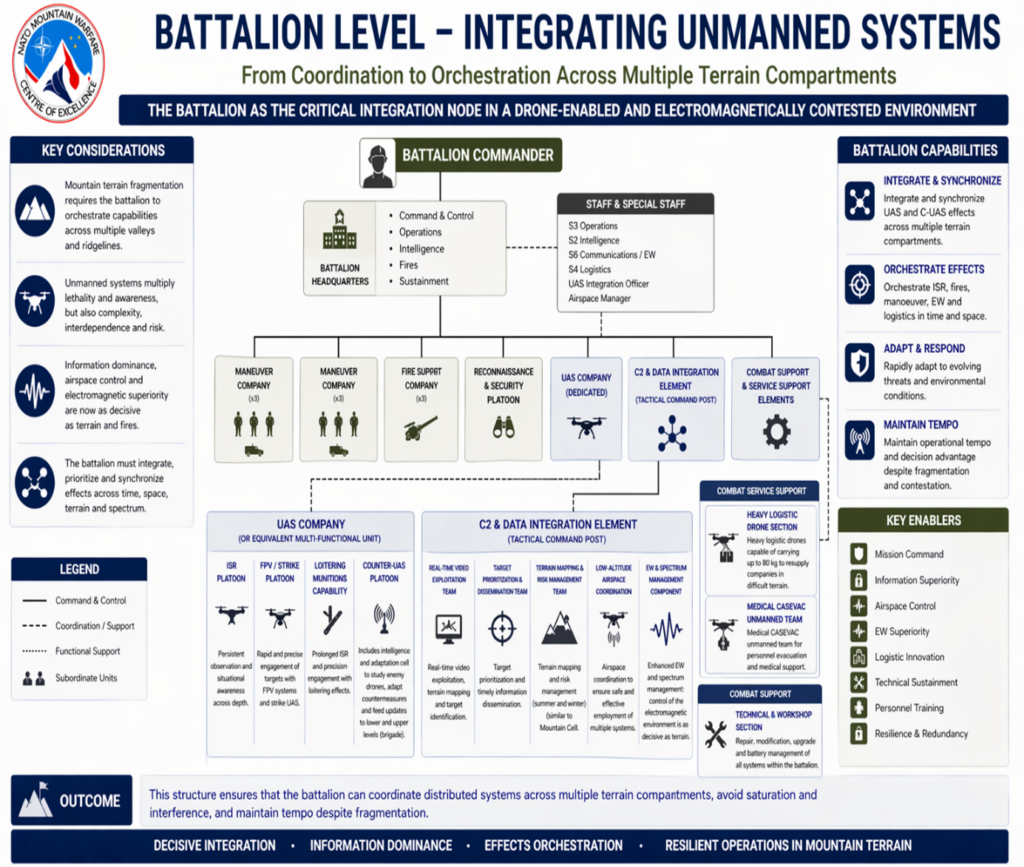
  • Integration must be centralized or coordinated, particularly at battalion level;
  • Training must involve the entire system, not only operators.

In short, limiting factor is no longer access to technology, but the ability to manage complexity, particularly in terms of information flow and coordination.

The experience of the 7th Alpini Regiment shows that meaningful integration is possible, but only when training, staff procedures, technical support, and command structures evolve together. At the same time, it also shows the limits of trying to absorb this transformation within existing organizational models.

This is the point where practical experimentation meets a broader doctrinal question. If unmanned systems are already influencing command posts, staff workloads, team composition, and sustainment, then adaptation can no longer remain partial or improvised. The next section moves from observed implementation to deliberate transformation, asking what kind of cultural, organizational, and procurement shift is required if FPV and drone-enabled operations are to become truly institutionalized at company and battalion level.

6.5 - From Concept to Transformation: FPV Employment and Structural Change

At this point of the workshop, the discussion naturally shifts from analysis to responsibility.

Up to now, the focus has been on understanding how the battlefield is changing, identifying the gaps, and reviewing existing experiences. But there is a moment in every discussion where continuing to describe the problem becomes insufficient. That moment was reached here.

The central idea emerging from this intervention is straightforward, but uncomfortable: we already know enough to act.

Drones are no longer niche capabilities. They are employed across the full spectrum of tactical activities—reconnaissance, targeting, logistics, psychological effects, and direct attack. They are not a specialization. And yet, mountain units remain only partially adapted to this reality. Not because the technology is missing, but because the system surrounding it—procurement, structure, training, and mindset—has not evolved at the same pace.

Addressing this gap requires more than incremental adjustments. It requires a cultural shift.

This shift begins with procurement. The current acquisition system is designed for large, complex platforms developed over long cycles. It is inherently incompatible with technologies that evolve rapidly, are often commercially available, and require continuous modification. Attempting to fit drones into this model inevitably slows adaptation and creates dependency.

What emerges instead is a different approach, one that places responsibility closer to the unit. If drones operate at company and battalion level, then adaptation must happen there as well. This implies giving commanders not only the tools, but also the freedom to experiment, to test solutions, and to accept failure as part of the process. It also implies building local capacity—repair, modification, and adaptation—so that units are not passive users of technology, but active participants in its evolution. Small Unit Leaders must be free to buy, test and fail.

This naturally leads to a second, more profound shift: the recognition that innovation does not originate at the top.

In highly dynamic environments, the fastest adaptation occurs where the problem is experienced directly. The operator, the small unit, the platoon—these are the levels where new solutions emerge, are tested, and either discarded or refined. Accepting this reality requires a change in perspective. It means accepting that not every attempt will succeed, and that failure is not inefficiency, but a necessary condition for progress.

The idea of “letting the squad fail” is not a provocation for its own sake. It reflects a fundamental truth: adaptation cannot be centralized when the environment evolves faster than the system. Big Companies are not the only one actor anymore.

However, empowering lower levels is only part of the solution. If drones are to be fully integrated, the structure of the force must reflect their role.

The current model remains characterized by limited availability of systems and a tendency toward centralized control and procurement. This creates a mismatch between capability and need. In practice, it results in insufficient density at the lowest levels, where speed and responsiveness are most critical.

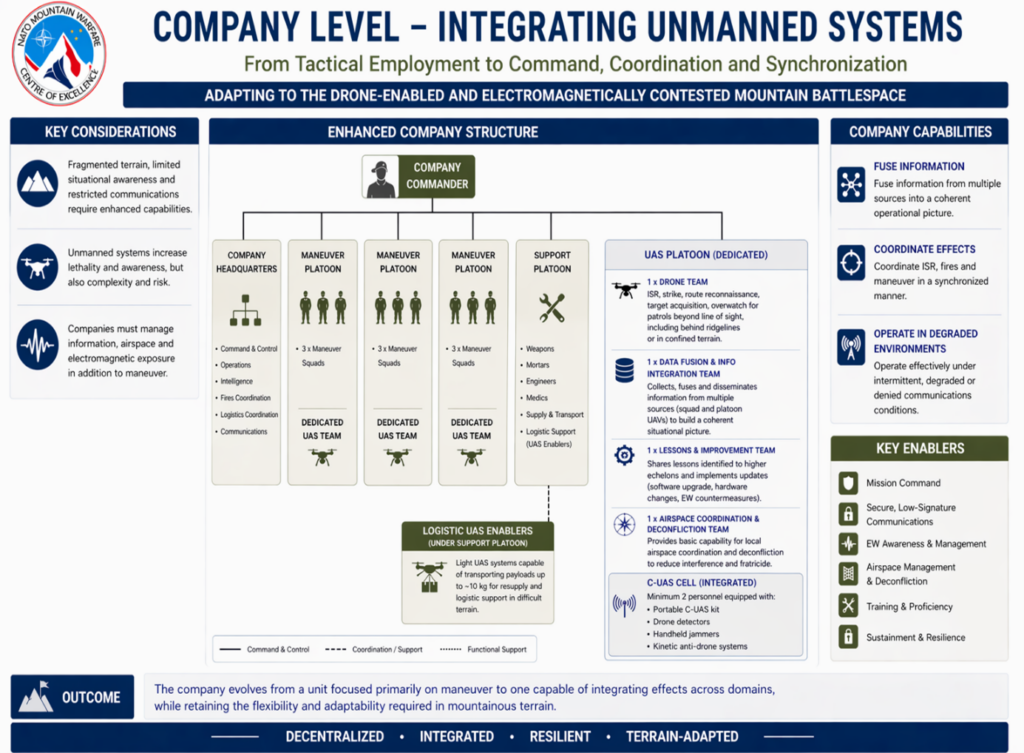
A different approach is required. Drone capabilities must be distributed across the force, embedded at every level, and aligned with the functions they are expected to perform. At company level, this means having organic capacity to observe beyond terrain obstacles, support maneuver, and contribute directly to targeting. In mountain warfare, this is not a luxury. It is a necessity. Without it, terrain becomes a limitation rather than a factor that can be exploited.

The current training system is not designed to produce personnel capable of employing unmanned systems at scale within complex environments such as mountains. It remains largely focused on traditional skills, with limited integration of new requirements. This creates a disconnect between what is needed and what is available. Bridging this gap requires more than adding new courses. It requires rethinking training as a whole, ensuring that operators, commanders, and staff are all prepared to function within a drone-enabled environment. Without this, any structural or technological change remains incomplete.

The discussion therefore cannot stop at employment. Once drones are integrated into maneuver, fires, logistics, and targeting, survivability becomes inseparable from the ability to detect, disrupt, and defeat hostile systems. The next section takes that step directly, shifting the focus from drone-enabled capability to Counter-UAS as a precondition for survival in mountain warfare.

7 - WORKSHOP DAY 2

7.1 – Counter-UAS and the Swarm Threat: From Vulnerability to Survivability

The increasing proliferation of unmanned aerial systems and the lessons emerging from recent conflicts, particularly the war in Ukraine, have fundamentally altered the relationship between force employment and force protection. Discussions on drone warfare often focus on how unmanned systems enhance reconnaissance, targeting, and strike capabilities. However, this represents only one side of the operational problem. The other, equally important, concerns survivabilityIf drones increasingly define the modern battlefield, Counter-UAS capabilities increasingly determine who can survive and operate effectively within it.

The widespread availability of low-cost FPV drones, loitering munitions, autonomous systems, and commercially adaptable UAS platforms has transformed aerial surveillance and precision engagement from specialized capabilities into persistent features of the operational environment. Tactical units are now subject to continuous observation, tracking, and potential engagement. In such an environment, the ability to generate combat effects is no longer sufficient. Operational success increasingly depends on the ability to survive and maintain freedom of action within a drone-saturated battlespace.

Recent conflicts have further demonstrated the growing operational relevance of coordinated drone attacks and swarm-like employment of unmanned systems. The challenge is no longer represented by isolated platforms but by multiple systems operating simultaneously, often designed to saturate defensive measures, overwhelm observation and engagement capacities, and significantly reduce available reaction times. Such attacks can generate disproportionate operational and psychological effects, particularly against units operating under constrained conditions.

These challenges are amplified in mountain warfare environments and traditional air defence concepts and centralized protection architectures alone are insufficient. A dedicated platoon, a single technological solution, or a so-called “silver bullet” approach cannot adequately address the complexity of the threat. Centralized systems frequently suffer from reduced coverage, delayed response times, and limited effectiveness across dispersed and compartmentalized terrain.

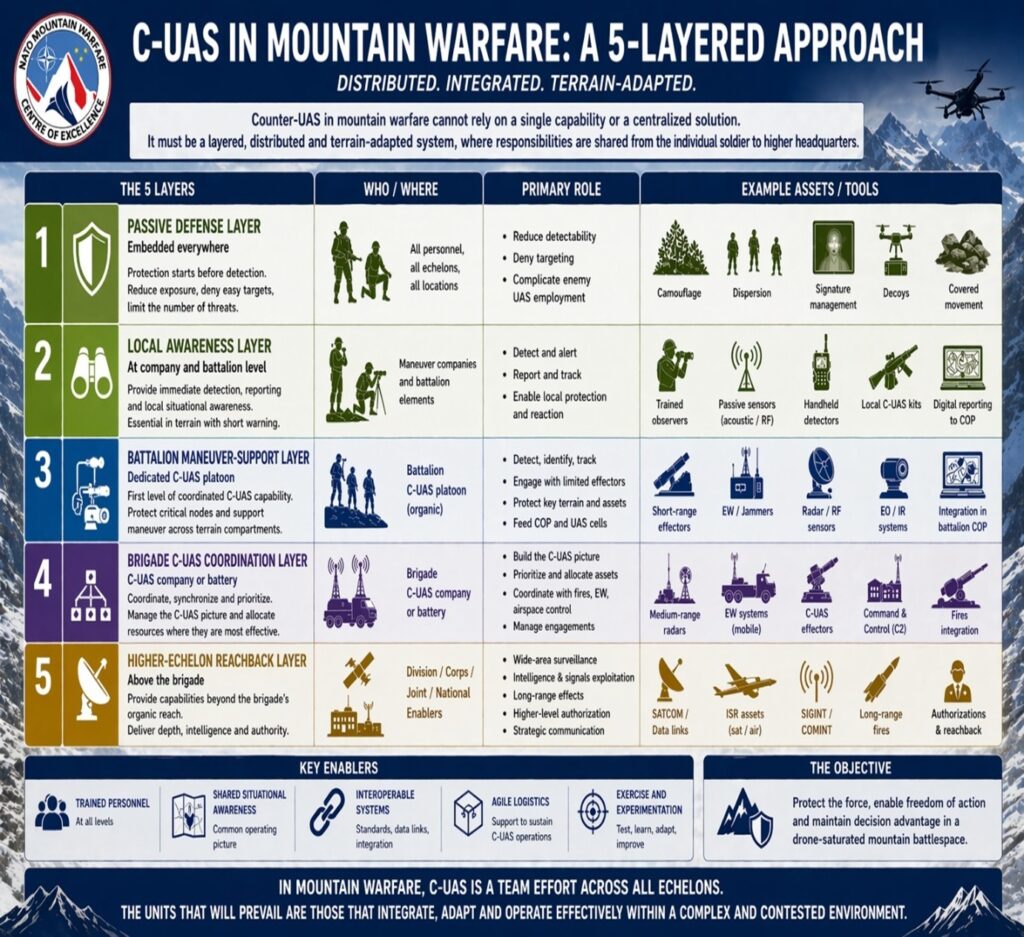
For this reason, Counter-UAS in mountain warfare must be understood as a distributed, layered, and decentralized capability integrated across the entire force. The battlespace itself imposes this requirement. Survivability begins at the lowest tactical level and does not initially depend on technology. Concealment, dispersion, signature management, camouflage discipline, deception, mobility, and sound fieldcraft remain the most effective and resilient countermeasures against persistent aerial observation. The conflict in Ukraine has repeatedly demonstrated that survivability increasingly depends on adaptation and movement rather than on static defensive positions. Units that fail to apply these principles expose themselves unnecessarily regardless of the technological systems available to them.

Building upon these passive measures, tactical units require the ability to achieve local situational awareness. In mountainous terrain, drones may appear with little warning due to terrain masking and environmental conditions. Company and platoon-level elements must therefore be capable of detecting, identifying, reporting, and reacting to drone activity independently and under degraded operational conditions. The objective is not to establish full control of the airspace but to avoid tactical surprise and maintain sufficient awareness to preserve operational freedom of action.

At higher tactical levels, the challenge evolves from detection to integration and coordination. Battalion-level formations must combine information from multiple sources, prioritize threats, allocate limited resources, and synchronize responses across dispersed units. Dedicated elements are required to integrate ISR assets, detection systems, electronic warfare capabilities, and available effectors into a coherent defensive framework. At brigade level and above, Counter-UAS becomes an architectural problem requiring the integration of detection networks, electronic warfare, kinetic systems, fires, communications, and airspace management within a common operational framework capable of adapting to both terrain constraints and evolving threats. Workshop activities and experimentation conducted by the MW COE further highlighted the importance of scalable and distributed defensive solutions. Traditional engagement models designed to counter individual aerial threats become increasingly ineffective when confronted by multiple simultaneous drones. This creates a structural mismatch between defensive systems optimized for sequential engagements and adversaries employing massed, low-cost aerial platforms intended to saturate available defences. Addressing this challenge requires low-cost, scalable, and distributed countermeasures capable of responding to multiple threats simultaneously. Particular relevance has been identified for portable Counter-UAS systems, decentralized electronic warfare and jamming capabilities, observation networks, rapid warning procedures, resilient communication systems, low-level airspace coordination measures, and modular defensive architectures deployable at company and platoon level.

Electronic warfare assumes a particularly important role within this framework because it offers the possibility of disrupting multiple unmanned systems simultaneously without relying exclusively on kinetic engagements. Nevertheless, no single capability can provide a complete solution. Effective Counter-UAS requires the integration of passive protection measures, camouflage discipline, deception, low-signature movement procedures, decentralized observation, electronic attack capabilities, kinetic defence systems, and robust command-and-control arrangements.

At the same time, Counter-UAS cannot be separated from UAS employment itself. In many operational contexts, friendly unmanned systems provide the most effective means of countering enemy drones through early warning, detection, tracking, and enhanced situational awareness. This reinforces the understanding that UAS and Counter-UAS are not distinct domains but interconnected components of a single operational ecosystem.

Ultimately, even the most sophisticated architecture remains ineffective without adequately trained personnel. Counter-UAS must therefore be regarded as a force-wide competency rather than a specialized function reserved for a limited number of experts. Every soldier requires a basic understanding of the threat, associated vulnerabilities, and immediate protective measures. Specialized personnel must be capable of operating sensors, managing information flows, and coordinating defensive responses, while units as a whole must integrate Counter-UAS considerations into routine planning, training, and execution. This requirement becomes even more demanding in mountain warfare, where altitude, weather, terrain, and seasonal variations continuously affect both unmanned systems and countermeasures. Capabilities effective in one environment may prove significantly less effective in another, making adaptation, repetition, and realistic training across diverse operational conditions essential prerequisites for maintaining survivability and operational effectiveness in future mountain warfare operations.

7.1.1 Conclusion

Counter-UAS fundamentally changes the logic of survivability. It is no longer sufficient to avoid contact or reduce exposure. Units must operate under the assumption that they are constantly observed and potentially targeted. The question is no longer how to avoid the threat, but how to survive within it.

This requires a shift from centralized solutions to distributed, layered, and terrain-adapted systems, supported by training, discipline, and coordination.

The discussion on Counter-UAS makes clear that survivability depends not only on structure and training, but also on the ability to operate when the electromagnetic environment is degraded or deliberately contested. In practice, many of the assumptions on which unmanned systems depend—location, timing, connectivity, and control—can no longer be treated as stable.

This brings the analysis to one of the most immediate and operationally relevant consequences of electronic warfare: the loss or corruption of GNSS-based navigation. The next section therefore focuses on GPS- and GNSS-denied environments, examining what happens when positional certainty disappears and how resilience can be built into the system from the outset.

7.2 – Operating Without GPS: GNSS Denial as the New Baseline. A technical perspective from our technological partner TimTec.

One of the most important shifts emerging from the workshop is the need to reconsider a fundamental assumption: GPS availability can no longer be taken for granted.

For years, GNSS has been treated as a stable and reliable enabler, underpinning navigation, targeting, synchronization, and command and control. This assumption is no longer valid.

The reality is that GPS denial—whether through jamming or spoofing—is not an exceptional condition, but an increasingly common feature of the battlefield. Systems that depend on uninterrupted GNSS access are therefore inherently vulnerable. This has direct implications for unmanned systems.

Drones rely heavily on positional awareness. Without it, their ability to navigate, coordinate, and execute missions degrades rapidly. However, the key takeaway from this session is not that GPS denial is a problem. It is that it must be treated as a design condition.

7.2.1 From Dependence to Resilience

Understanding GNSS is important, but the operational implication is simple: it is a low-power, easily disruptable signal. The frequencies used are inherently vulnerable to interference, and even relatively unsophisticated actors can degrade or deny access to reliable positioning. Two primary threats define this environment.

The first is jamming, which increases noise to the point where the signal becomes unreadable. The second is spoofing, which is more subtle and potentially more dangerous, as it feeds false positional data to the system without interrupting the signal itself. The operational effect is clear:
a drone may not simply stop working—it may continue operating incorrectly.

This distinction is critical. A system that fails is a problem. A system that provides wrong data is a much more dangerous one.

7.2.2 Detection Is Not Enough

The first step in operating under GNSS denial is detection. Changes in signal strength, unexpected positional shifts, or inconsistencies in movement patterns can indicate interference. These indicators allow systems to recognize that GPS data is no longer reliable.

However, detection alone does not solve the problem. Once GNSS is denied or compromised, the system must be able to continue operating. This is where the discussion moves from awareness to resilience.

7.2.3 Navigation Without GPS

What emerges clearly is that there is no single alternative to GPS. Instead, resilience is achieved through sensor fusion.

Inertial navigation provides the first layer. Using accelerometers, gyroscopes, and magnetometers, it allows a system to estimate position and movement independently. However, this solution is inherently imperfect. Over time, errors accumulate, and the system begins to drift. To compensate for this, additional inputs are required.

Vision-based systems provide a second layer. By analysing images and tracking features in the environment, drones can estimate movement relative to the ground. Techniques such as optical flow allow the system to calculate translation and rotation, effectively reconstructing movement even in the absence of external signals.

More advanced approaches introduce semantic understanding. By recognizing patterns, terrain features, and environmental structures, systems can localize themselves and correct drift. This represents a significant step toward autonomy, allowing drones to operate in complex environments even under heavy interference.

Other methods, such as horizon detection or the use of terrain maps, further reinforce this capability, particularly in mountainous environments where terrain features are pronounced and can be exploited for navigation.

What emerges is not a replacement for GPS, but a layered system in which multiple sensors compensate for each other.

7.2.4 The Cost of Resilience

However, this resilience comes at a cost. Each additional sensor increases complexity, power consumption, and cost. It also introduces new requirements in terms of calibration, processing power, and integration. Systems become more capable, but also more demanding.

This creates a fundamental trade-off. Low-cost, expendable drones can be produced in large numbers, but have limited resilience. More advanced systems can operate in denied environments, but are fewer, more expensive, and more complex to sustain.

This tension reflects a broader challenge already highlighted in previous sections: the balance between mass and capability.

7.2.5 Implications for Mountain Warfare

In mountain environments, these challenges are amplified. Terrain interferes with satellite visibility, reducing signal quality even in uncontested conditions. Valleys, ridgelines, and dense vegetation create natural obstacles that degrade GNSS performance. When combined with deliberate jamming or spoofing, this results in environments where GPS may be unreliable or unavailable for extended periods.

At the same time, terrain provides an opportunity. Distinct geographical features—ridges, slopes, horizons—can be used as reference points for alternative navigation methods. Systems that are able to exploit these features can achieve a level of resilience that would not be possible in more uniform environments.

This reinforces a key idea: Mountain Warfare does not only complicate the problem. It also provides part of the solution.

7.2.6 Conclusion

GNSS denial fundamentally changes the way unmanned systems must be designed and employed. It is no longer sufficient to assume availability and build redundancy around it. Instead, systems must be conceived from the outset to operate without it.

GPS is no longer a guarantee. It is an advantage—when available. Operational effectiveness therefore depends on the ability to combine multiple navigation methods, accept limitations, and adapt employment accordingly.

GNSS denial illustrates one specific aspect of a broader operational reality: modern unmanned systems do not merely operate in difficult terrain, but in a battlespace where the entire electromagnetic domain is contested. Loss of navigation is therefore not an isolated technical problem; it is one manifestation of a wider struggle over connectivity, control, and information.

To understand the full implications, the discussion must move beyond positioning alone and examine how systems maintain mission continuity when the spectrum itself becomes unstable. The next section expands the focus accordingly, addressing electromagnetic resilience as a whole and exploring how communications, autonomy, swarm behaviour, and deconfliction must be rethought in mountain warfare.

7.3 – EW Resilience and Deconfliction: Fighting in a Contested Spectrum. Another technical perspective from our technological partner

If the previous section establishes that GNSS denial is becoming the norm, this session expands the perspective further. The problem is not GPS. The problem is the spectrum.

What emerges clearly is that modern operations—especially those involving unmanned systems—are fully dependent on the electromagnetic environment. Communications, navigation, control links, data exchange: everything relies on it.

And in mountain warfare, that environment is not only contested. It is inherently unstable.

Electronic warfare is therefore not an additional layer of complexity. It is the environment in which the fight takes place.

7.3.1 A Battlespace Shaped by Terrain and Spectrum

The first key insight is that mountain terrain does not simply complicate operations. It actively shapes the electromagnetic environment.

Line-of-sight is constantly interrupted. Valleys and ridgelines create shadow zones where signals are degraded or completely lost. At the same time, reflections and multipath effects distort signals, affecting both communications and navigation. This has two immediate consequences.

First, connectivity becomes fragmented. Units cannot rely on stable links, and communication must be continuously re-established and adapted.

Second, the effectiveness of electronic warfare is amplified. Even relatively low-power jammers can achieve significant effects when terrain funnels and concentrates signals. In valleys, for example, spoofing and jamming become easier due to reflections and constrained geometry.

The result is a battlespace where disruption is not occasional—it is persistent.

7.3.2 Resilience by Design, Not by Addition

Faced with this reality, the traditional approach—adding protection layers to existing systems—is insufficient. Resilience must be built into the system from the outset.

This applies first to communications. Instead of relying on single links or centralized nodes, systems must adopt distributed and adaptive networking models. Mesh networks, terrain-aware routing, and directional communications allow connectivity to be maintained even when parts of the system are degraded. The concept of “self-healing connectivity” captures this idea well. High-altitude platforms provide line-of-sight and sensing, intermediate relays bridge terrain obstacles, and lower-level systems operate tactically within the environment. Together, they form a network that can adapt dynamically to disruption.

This is not redundancy in the traditional sense. It is adaptability under pressure.

7.3.3 Autonomy as a Requirement, Not an Option

As connectivity becomes less reliable, the role of autonomy increases.

Systems must be able to continue operating even when communication is degraded or lost. This includes the ability to navigate without GNSS, adapt missions in real time, and maintain coordination within a swarm or distributed system.

Autonomy is therefore not about efficiency. It is about mission continuity. The integration of onboard processing, AI-supported decision-making, and real-time detection of electronic interference allows systems to react immediately, rather than waiting for external input.

This becomes particularly relevant in swarm operations.

7.3.4 Swarm Logic and Resilient Systems

Swarm operations introduce a different model of resilience. Instead of relying on the survivability of individual platforms, they rely on the resilience of the system as a whole. If one node is lost or disrupted, others compensate. Data is rerouted, roles are redistributed, and the mission continues. This creates a structure that is inherently difficult to neutralize.

From an EW perspective, this presents a significant challenge. Jamming or disrupting a single link is no longer sufficient. The system adapts, reconfigures, and continues operating. Even partial disruption does not necessarily translate into mission failure.

In mountainous terrain, this is further enhanced by the ability of swarms to occupy different altitudes and positions, effectively filling gaps in coverage and maintaining connectivity across fragmented terrain.

7.3.5 The Hidden Risk: Fratricide and Interference

However, increased use of the spectrum introduces a new and often underestimated risk.

Not all interference is enemy interference. As multiple systems operate simultaneously—drones, artillery, loitering munitions, electronic warfare assets—the battlespace becomes congested. This is particularly evident in what is described as the TRSC environment, where multiple effectors and systems operate concurrently within the same space.

In such conditions, the risk of:

  • friendly interference
  • signal overlap
  • and even fratricide

increases significantly. This is especially critical in mountain warfare, where terrain already fragments the force and limits situational awareness.

7.3.6 Deconfliction as a Core Function

This leads to the final, and perhaps most important, aspect of this session: deconfliction.

Deconfliction is often treated as a procedural requirement. In reality, it becomes a core operational function.

The proposed framework highlights a layered approach. At the lowest level, spectrum management ensures that systems do not interfere with each other. Above this, airspace deconfliction organizes the vertical and horizontal use of space. This is followed by integration with fires and other effectors, ensuring that actions are coordinated rather than conflicting. Finally, identification and safety mechanisms reduce the risk of fratricide.

What is important here is not the structure itself, but the implication. Deconfliction is no longer a staff activity. It is a continuous process that must be understood and applied at multiple levels.

From platoon to company level, commanders must understand who controls what, how the battlespace is organized, and how different systems interact. Without this understanding, increased capability leads to increased risk.

7.3.7 Adapting to the Environment

The session also highlights a number of practical adaptations that reflect this reality. Terrain masking, for example, can be used not only for protection, but also as a way to reduce exposure to electronic warfare. Similarly, last-mile autonomy allows systems to complete missions even when links are disrupted.

At the same time, rapid iteration becomes essential. Procedures, configurations, and tactics must be continuously adjusted based on observed effects. Static solutions quickly become obsolete in a dynamic electromagnetic environment.

7.3.8 Conclusion

Electronic warfare fundamentally reshapes the operational environment.

It affects how systems communicate, how navigate, coordinate and ultimately, whether they can complete their mission.

In mountain warfare, these effects are amplified by terrain, creating a battlespace that is both physically and electromagnetically complex. Survival and effectiveness depend on the same factors: adaptability, redundancy, and autonomy.

At this point, the technical and tactical picture is complete. The workshop has shown that unmanned systems, counter-UAS, navigation resilience, and spectrum management cannot be treated as separate issues. They form a single operational problem that cuts across tactics, command structures, training, and survivability.

The remaining challenge is therefore not analytical, but institutional: how to translate this growing body of operational insight into doctrine, training standards, and force development. The next section addresses precisely that question, examining how battlefield innovation can be captured, validated, and transformed into doctrinal guidance rather than remaining fragmented at local level.

7.4 – From Battlefield Innovation to Doctrine: Bridging the Gap

At this stage, the discussion reaches its natural conclusion. After analysing the operational environment, reviewing field experiences, and proposing structural and procedural adaptations, a final question remains: how do we transform what we have observed into doctrine?

This is not a trivial step. It is, in many ways, the most difficult one. The transition from battlefield innovation to doctrinal development is not automatic. It requires a structured process capable of translating experience into standardized knowledge, and ultimately into training and operational practice. The framework presented highlights that this process is already defined, but not always fully exploited.

At its core, the process follows a continuous cycle: experimentation, standardization, training, and lessons learned, all feeding back into each other. This cycle is not theoretical. It represents the mechanism through which NATO adapts to changes in the operational environment.

However, the effectiveness of this process, in a Mountainous environment, depends on one critical condition: it must remain connected to the field.

One of the key insights emerging from the discussion is that innovation cannot be developed in isolation. Testing, validation, and refinement must involve operational units at every stage. Individual testing may confirm that a system works. Battalion-level experimentation demonstrates whether it adds tactical value. Only at the integration level does it become clear whether it can function within a broader system, interacting with other capabilities and contributing to operational outcomes.

This highlights a recurring issue. Too often, innovation is treated as a technical problem, focused on the performance of individual systems. In reality, the challenge lies in integration within a system of systems, where interfaces, coordination, and information flow become decisive.

The example of logistics experimentation further illustrates this point. Comparing traditional solutions, such as cableways, with emerging drone-based approaches shows that no single solution is universally superior. Each brings advantages and limitations, depending on terrain, weather, and operational constraints. What matters is not the platform itself, but the ability to combine different solutions into a coherent system, adapted to the environment.

This reinforces a broader principle: innovation is not about replacing existing capabilities, but about reconfiguring how they are combined and employed.

At the same time, the discussion highlights the importance of operating across all levels of warfare. Tactical innovation, such as the use of drones at company level, must be connected to operational and strategic frameworks. Without this connection, local adaptations remain isolated and cannot be scaled or standardized. This creates a natural tension between decentralization and coherence.

On one hand, adaptation must occur at the lowest levels, where the problem is experienced directly. On the other hand, doctrine requires consistency, interoperability, and a shared understanding across the Alliance. Bridging this gap requires a process that allows innovation to emerge from below, while ensuring that it is captured, analysed, and translated into doctrine.

This is precisely the role of organizations such as MWCOE.

The workshop itself can be seen as part of this process. It represents a point within the broader cycle, where observations, experiences, and ideas are collected and refined. However, its value depends on what follows. Without a deliberate effort to transform these insights into structured outputs—doctrinal proposals, training adaptations, and standardized procedures—the knowledge generated risks remaining fragmented.

7.4.1 Conclusion

The transition from innovation to doctrine is not a linear process. It is a continuous cycle that depends on the interaction between:

  • field experience
  • experimentation
  • analysis
  • and standardization

The key challenge is not generating ideas, but ensuring that they are captured, validated, and translated into usable doctrine.

Without this step, innovation remains local.

This brings the report to its final stage. The preceding sections have described not only how unmanned systems are transforming mountain warfare, but also how that transformation affects force structure, low airspace integration, survivability, training, navigation, and spectrum resilience.

The final step is to move from analysis to action. The next section therefore consolidates the principal findings of the workshop and translates them into recommendations for NATO mountain warfare units, with particular attention to doctrine, training, force design, and capability development.

8 - Key Findings and Recommendations to NATO Mountain Warfare Units

8.1 – Key Findings

The workshop confirms a reality that is no longer emerging, but already established. Unmanned systems are not simply adding a new layer to the battlefield; they are reshaping its fundamental dynamics. Their impact extends well beyond technology, influencing how forces observe, decide, act, and ultimately survive.

The first and most immediate consequence of this transformation is the shift toward persistent observation. Units can no longer assume that exposure is temporary or manageable. Detection is increasingly continuous, and once achieved, engagement follows rapidly. This compresses time, reduces reaction windows, and forces a reconsideration of what survivability actually means. Protection is no longer primarily achieved through physical measures, but through dispersion, mobility, and the reduction of signatures across all domains.

At the same time, the widespread availability of drones has driven a decentralization of capability. Functions that were once centralized—reconnaissance, targeting, and even strike—are now available at company level. This increases the autonomy of tactical units and accelerates decision-making, but it also introduces a new layer of complexity. As capabilities spread downward, the need for coordination increases upward. Battalion-level structures, in particular, emerge as critical nodes for integrating multiple systems and maintaining coherence.

A third major finding concerns the growing gap between operational reality and institutional adaptation. The battlefield evolves through rapid experimentation, continuous feedback, and immediate adaptation. In contrast, doctrinal development, procurement cycles, and training systems operate on longer timelines. This mismatch does not reflect a lack of capability, but a lack of alignment. Without addressing it, even advanced systems risk being employed below their potential.

Another defining element is the transformation of the electromagnetic environment. GNSS denial, communications disruption, and electronic warfare are no longer exceptional conditions. They are part of the baseline. This fundamentally changes how systems must be designed and employed. Dependence on stable connectivity or precise positioning becomes a vulnerability unless mitigated through redundancy, adaptability, and alternative solutions.

Within this context, Counter-UAS emerges not as a specialized capability, but as a core condition for survivability. The ability to detect, disrupt, and mitigate the effects of enemy drones is no longer confined to dedicated units. It must be understood and applied across the force, at all levels, and integrated into everyday operations.

Taken together, these findings lead to a clear conclusion: once again, the challenge is no longer to introduce drones into existing structures, but to adapt those structures to a battlefield in which drones are already central.

8.2 – General Recommendations

The implications of these findings are not abstract. They translate into a set of practical directions that require action across doctrine, training, organization, and capability development. These are not long-term ambitions, but necessary steps to ensure relevance in the current operational environment.

Doctrine represents the first area of adaptation. It must evolve to reflect the fact that unmanned systems are not supporting elements, but integral components of all warfighting functions. This requires moving beyond platform-centric approaches and recognizing drones as part of a broader system that connects sensing, decision-making, and effects. Planning processes must incorporate unmanned capabilities from the outset, while procedures must address the realities of operating in a saturated and contested airspace. Equally important is the need to treat UAS and Counter-UAS as interconnected elements of the same operational framework.

Training must follow the same logic. Exposure to drone-enabled environments can no longer be limited to specialists or isolated courses. It must become a routine part of training at all levels. This includes not only operators, but commanders and staff, who must be capable of managing information flows, coordinating multiple systems, and making decisions under conditions of degraded connectivity. Training must also reflect the realities of the electromagnetic environment, preparing units to operate without reliable GNSS or communications.

Force structure represents another critical area. The distribution of capabilities must align with their operational role. At company level, units require organic unmanned capabilities to maintain situational awareness and support maneuver. At battalion level, the focus shifts toward integration. Dedicated elements are needed to coordinate systems, manage data, and link sensors to effects. At the same time, Counter-UAS capabilities must be distributed, ensuring that survivability does not depend on a single node, but is embedded across the force.

Procurement and innovation require a more fundamental shift. Traditional acquisition models are not suited to technologies that evolve rapidly and require continuous adaptation. A more flexible approach is needed, allowing units to experiment, adapt, and iterate based on operational feedback. This implies a greater degree of decentralization, where innovation is not imposed from above, but emerges from interaction with real-world problems.

The electromagnetic domain must be addressed explicitly. Operations must be designed from the outset to function in a contested spectrum. This means reducing dependence on GNSS, developing alternative navigation methods, and adopting communication architectures that can adapt to disruption. Resilience cannot be added later; it must be embedded in both systems and procedures.

Finally, the management of low airspace must be recognized as a core operational function. As the number of systems increases, so does the risk of interference and fratricide. This requires the adoption of simple, scalable coordination measures and a clear definition of roles across echelons. Integration must be achieved without creating excessive centralization, balancing control with flexibility.

Across all these areas, a common principle emerges: adaptation must be both distributed and coordinated. It must occur at the lowest levels, where problems are experienced directly, but it must also be captured, structured, and shared to ensure coherence across the Alliance.

9 - Proposal for a New Mountain Troops Force Structure Up to Battalion Level

9.1 – Introduction

The force structure outlined below represents a conceptual proposal developed through a combination of analytical studies, operational observations, experimentation activities, and iterative refinement. It is the result of workshops, expert discussions, and continuous exchanges among subject matter experts, practitioners, and representatives from multiple NATO nations. These interactions have enabled the consolidation of diverse perspectives, lessons identified, and emerging best practices related to the employment of unmanned systems in mountain warfare. As such, this proposal should not be considered prescriptive, but rather as a contribution to the ongoing doctrinal evolution, intended to stimulate further discussion, experimentation, and validation across the Alliance. Its purpose is to support a shared understanding and provide a practical framework that can be adapted, tested, and refined by NATO nations according to their specific operational contexts, force structures, and capabilities.

The findings of the workshop clearly indicate that current force structures are not fully aligned with the operational realities of a drone-enabled battlefield. While existing organizations provide a solid foundation, they were not originally designed to operate in an environment characterized by persistent observation, distributed capabilities, contested electromagnetic spectrum, and the widespread employment of unmanned systems. Adapting to this environment does not necessarily require a complete redesign of existing organizations. However, it does require a systematic evolution aimed at integrating unmanned capabilities as organic and essential components at every level of command.

The organizational integration of unmanned systems will largely depend on the type of system employed, its operational purpose, and the existing force structure of individual nations. Consequently, no universal organizational model can be applied across all mountain warfare forces. Different operational requirements, national doctrines, available resources, and organizational cultures will inevitably generate different implementation approaches. Nevertheless, recent operational experience and experimentation activities suggest a number of common principles that can guide future force development.

At the lowest tactical echelons, the integration of unmanned systems must become fully normalized. Small UAS with a take-off weight below approximately 2.5 kilograms can generally be integrated directly into squad, platoon, and company-level organizations, where they provide commanders with organic reconnaissance, situational awareness, and limited targeting capabilities. These systems must remain simple, robust, portable, and directly integrated into maneuver, allowing small units to operate with increased autonomy while maintaining awareness beyond terrain constraints.

As system size, complexity, endurance, and mission requirements increase, dedicated organizational solutions become necessary. Medium-range reconnaissance systems, FPV platforms, loitering munitions, logistics drones, electronic warfare payloads, and Counter-UAS capabilities require specialized personnel, technical support, maintenance procedures, and command-and-control arrangements that exceed the capabilities of individual operators. The integration of unmanned systems should therefore not be viewed simply as the introduction of new equipment, but as the development of an interconnected capability involving operators, analysts, maintainers, commanders, and support personnel.

Operational experience has consistently demonstrated that successful employment of UAS capabilities depends on more than a single operator. Effective drone operations require mission planning, system operation, intelligence exploitation, technical maintenance, communication management, airspace coordination, and integration with supported units. The organizational integration of unmanned systems therefore requires dedicated and properly trained personnel at every level. Depending on the mission and echelon, crews may consist of multiple personnel performing complementary functions such as command and control, platform operation, sensor exploitation, target identification, battle damage assessment, technical support, and spectrum management.

At company level, the role of unmanned systems expands significantly. Companies must be capable not only of employing drones for reconnaissance, but also of supporting targeting processes, coordinating fires, managing information flows, contributing to local airspace management, and implementing basic Counter-UAS measures. This requires dedicated personnel with clearly defined responsibilities and the ability to integrate sensor data into the decision-making process while maintaining coordination with adjacent units and higher headquarters.

The battalion level becomes the decisive integration node. As the density and diversity of systems increase, the challenge shifts from employment to coordination. Battalion structures should therefore include dedicated elements responsible for integrating ISR and targeting data, managing low-altitude airspace and deconfliction measures, coordinating UAS and Counter-UAS activities, supporting command and control through data processing and prioritization, and managing the increasing complexity of operations in the electromagnetic domain. These functions should not be viewed as additional layers of bureaucracy, but as necessary adaptations to prevent system saturation and maintain operational coherence.

At brigade level, the focus moves toward synchronization, interoperability, and operational depth. Brigade commands must be capable of integrating multiple battalion-level systems into a broader operational framework, ensuring continuity of information, efficient resource allocation, and alignment with higher-level effects, including joint and multi-domain operations.

A key characteristic of the proposed structure is the balance between decentralization and coordination. Capabilities must be distributed throughout the force to ensure responsiveness, adaptability, and resilience, while coordination mechanisms must remain sufficiently robust to prevent fragmentation, duplication of effort, and fratricide. This balance reflects the realities of mountain warfare, where terrain, weather, and human performance continue to shape operations and where tactical execution is frequently decentralized to battalion level and below.

The emergence of persistent ISR, unmanned systems, and electromagnetic contestation is profoundly altering how these formations must operate. The challenge is therefore not to replace existing structures, but to adapt them to function effectively within a technologically saturated and continuously observed battlespace. Ultimately, the objective is not to create a force that uses drones, but a force that is structurally designed to operate, survive, and prevail in a drone-enabled environment.

9.2 – Design Principles

The proposed evolution of mountain force structure is guided by four key principles:

  • Decentralized lethality and awareness at the lowest levels
  • Integration rather than aggregation of unmanned capabilities
  • Resilience in degraded environments (C2, GNSS, communications)
  • Terrain-adapted modularity, preserving flexibility across operational levels

These principles remain consistent with doctrinal requirements for mission command and decentralized execution in mountainous terrain, while extending them into the digital and electromagnetic domains.

9.3 – Sub-Unit Level (Squad / Platoon)

At the squad levels, units must be capable of operating with a high degree of autonomy within isolated terrain compartments. This requirement, already central to mountain warfare, becomes even more critical in a battlespace characterized by persistent observation and limited situational awareness.

Every squad should be equipped with one additional UAS operator (or as additional task to a squad soldier) capable to use

  • organic micro-UAS for immediate reconnaissance (small – short range – light)
  • limited loitering or precision strike capability, ISR
  • secure, low-signature communication systems
  • UAV with modular design and different payload/sensors based on mission, not limited to open air but even for caves, wood and ridges.

These systems must remain simple, portable, and adapted to the terrain. In particular, platforms should support modular payload configurations, allowing employment not only in open environments but also in complex terrain such as forests, ridgelines, and confined spaces including caves. Secure, low-signature communication systems are essential to ensure survivability and reduce electromagnetic exposure. As at squad level, modularity remains essential. Platforms should be adaptable to mission requirements and terrain conditions, ensuring flexibility across different operational scenarios. Secure and resilient communication systems remain a critical enabler, particularly in environments where connectivity is degraded or contested.

The objective at this level is not to create a specialized capability, but to extend the squad’s natural ability to observe and act beyond line of sight, without increasing its physical footprint. Unmanned systems therefore become an integral part of maneuver, directly supporting movement, security, and engagement.

At the squad level, unmanned systems are not specialized assets but integrated tools within maneuver, directly supporting movement, security, and engagement.

At platoon level, the scale and complexity of operations require a more structured approach. Each platoon should include a dedicated UAS team, capable of employing larger short-range systems with increased endurance and sensor capability. These systems should support not only reconnaissance, but also target acquisition, fire adjustment, and, where required, specialized tasks such as CBRN detection. UAV with modular design and different payload/sensors based on mission, not limited to open air but even for caves, wood and ridges

The platoon UAS team should typically consist of three to four personnel, depending on the mission and task organization. In its basic configuration, a three-person team would include:

  • a team leader responsible for mission command and target allocation
  • an operator responsible for system control and engagement
  • a UAS specialist responsible for logistics, reconfiguration, and system support

For more complex missions, a four-person configuration allows for greater functional specialization:

  • a team leader responsible for coordination and situational awareness
  • an operator responsible for drone control, data exploitation, and target tracking
  • an observer supporting target selection, engagement confirmation, and battle damage assessment
  • a technical specialist responsible for system preparation, maintenance, and signal management

This structure allows the platoon to move beyond simple drone employment and toward integrated ISR and targeting support, while maintaining the flexibility required in mountainous terrain.

9.4 – Company Level

At company level, the integration of unmanned systems transitions from a purely tactical function to a command, coordination, and synchronization function. While the company retains its classical structure—Company Headquarters, three maneuver platoons, and one support platoon—this configuration alone is no longer sufficient to operate effectively in a drone-enabled and electromagnetically contested battlespace.

Mountain warfare doctrine already highlights that company-level commanders operate in fragmented terrain, often with limited situational awareness and restricted lines of communication. The widespread employment of unmanned systems amplifies both the opportunities and the risks associated with this environment. As a result, companies must evolve to manage not only maneuver, but also information flow, airspace usage, and electromagnetic exposure.

A dedicated UAS platoon should be established as an organic element of the company. This platoon would provide the company commander with the ability to generate, sustain, and coordinate unmanned effects across multiple terrain compartments. The UAS platoon should include:

  • one drone team, structured similarly to platoon-level UAS teams, capable of conducting ISR, precision strike, route reconnaissance, and target acquisition, as well as providing overwatch for patrols operating beyond line of sight, particularly behind ridgelines or within confined terrain
  • one team dedicated to data fusion, information integration, and dissemination, responsible for collecting, processing, and distributing information from multiple sources, including squad and platoon-level UAVs. This function is critical to prevent information overload, ensure that collected data is transformed into actionable information, and enable the company to move from isolated drone employment toward a coherent and shared situational picture, which is essential in mountainous environments where units operate in dispersed and partially disconnected conditions
  • one team responsible for capturing, sharing, and implementing lessons identified, both upward and downward. This includes the integration of updates related to software, hardware modifications, and electronic warfare countermeasures
  • one team capable of providing a basic capability for local airspace coordination and deconfliction. Given the density of unmanned systems operating at low altitude, particularly in mountainous terrain where vertical and horizontal separation are limited, the risk of interference and fratricide increases significantly. Simple, scalable procedures and clearly defined responsibilities are therefore essential
  • one team capable of a dedicated Counter-UAS (C-UAS) cell should be integrated within the companyy. This cell should consist, at a minimum, of two trained personnel equipped with portable counter-UAS systems, including handheld detectors, jammers, and, where available, kinetic anti-drone solutions. The purpose of this element is not to create a centralized defensive capability, but to provide the company with immediate protection against low-altitude threats, particularly in situations where support from higher echelons is delayed or unavailable due to terrain constraints.

The existing support platoon must integrate a team capable of providing a limited but effective logistic support capability using light UAV systems. These systems, capable of transporting payloads of up to approximately 10 kg, can support the resupply of forward elements operating in difficult terrain, reducing physical exposure and increasing operational endurance

Taken together, these adaptations reflect the increasing complexity of operating multiple systems within restricted terrain compartments. In mountain warfare, where movement is constrained and observation is limited, the ability to manage airspace, information, and electromagnetic signatures becomes as important as the ability to maneuver.

In this context, the company should be able to:

  • fuse information from multiple sources into a coherent operational picture
  • coordinate ISR, fires, and maneuver in a synchronized manner
  • operate effectively under intermittent, degraded, or denied communications conditions

Ultimately, the company evolves from a unit focused primarily on maneuver to one capable of integrating effects across domains, while retaining the flexibility and adaptability required in mountainous terrain.

9.5 – Battalion Level (Decisive Integration Node)

At battalion level, the integration of unmanned systems evolves from coordination at company level to full-spectrum orchestration of capabilities across multiple terrain compartments.

In mountain warfare, the battalion already represents the highest echelon capable of effectively controlling maneuver, due to terrain fragmentation and limited mobility. In a drone-enabled battlespace, this role expands significantly. The battalion becomes the central node for integration, prioritization, and synchronization of all unmanned and counter-unmanned activities.

While retaining its classical structure—Battalion HQ, maneuver companies, and combat support elements—the battalion must evolve to manage not only maneuver and fires, but also data flows, airspace control, and electromagnetic effects across depth.

In a drone-enabled battlespace, the battalion becomes the critical integration node, requiring structural adaptation. It should include:

  • a UAS Company or equivalent multi-functional unit, integrating:
    • ISR platoon
    • FPV/strike platoon
    • loitering munitions
    • Counter-UAS platoon that include an intelligence and adaptation cell, capable of study enemy drones, adapt countermeasure quickly and feed update to down and upper level (brigade)
  • a C2 and data integration element (tactical command post), composed by:
    • a dedicated team for real time video exploitation, terrain mapping and target identification
    • a team for target prioritization and dissemination
    • a team for terrain mapping and risk management (summer and winter) (similar to Mountain Cell)
    • low-altitude airspace coordination, ensuring safe and effective employment of multiple systems
    • an enhanced EW and spectrum management component, recognizing that control of the electromagnetic environment is now as decisive as terrain

Inside the Combat Service Support

  • a dedicated heavy logistic drone section must be implemented to carry up to 80 kg to resupply companies in difficult terrain
  • a dedicated medical CASEVAC unmanned team should be created

Inside the Combat Support a dedicated technical and workshop section in charge of repair, modification, upgrade and battery management of all system inside the battalion

Taken together, this structure enables the battalion to effectively coordinate distributed systems across multiple terrain compartments, while avoiding saturation and interference, and maintaining operational tempo despite fragmentation.

9.6 – Conclusion

The proposed force structure does not aim to create a technologically dependent force, but a force that is structurally adapted to operate in a battlespace where observation is constant, signatures are contested, and tempo is driven by information flow as much as by movement.

10 - An audacious Training Solution for MW, individual and collective (Proposal)

The effectiveness of the proposed force structure is inherently dependent on the ability of units to train, adapt, and operate within a drone-enabled and electromagnetically contested environment. While ATrainP-6 provides a solid and comprehensive foundation for mountain warfare training, the evolving operational context requires a progressive adaptation of training methodologies, rather than a complete redesign.

Mountain warfare training has traditionally emphasized physical resilience, small-unit autonomy, and the ability to operate in complex and restrictive terrain. These principles remain fully valid. However, they must now be complemented by the integration of unmanned systems, data-driven decision-making, and operations in degraded environments.

In this context, the objective is not to replace existing training frameworks, but to expand and evolve them, ensuring that unmanned capabilities are fully embedded within current standards and practices.

A first key requirement is the systematic integration of unmanned systems into all training activities. UAS should not be treated as a standalone subject, but as a constant presence across individual, collective, and combined training. This includes both friendly and adversary drone employment, ensuring that units are exposed not only to the opportunities provided by unmanned systems, but also to the constraints and risks associated with operating under persistent observation.

Equally important is the introduction of degraded and denied conditions as a training baseline. ATrainP-6 already recognizes the challenges posed by terrain and weather; this must now be extended to include routine exposure to GNSS denial, communications disruption, and electronic warfare effects. Training environments should therefore deliberately incorporate these factors, forcing units to develop alternative procedures, reinforce adaptability, and reduce dependence on vulnerable systems.

Training must also evolve from a focus on individual operators/skills to a focus on the integration of the entire system. Commanders, staff, and support elements must be trained to manage increased information flow, coordinate multiple unmanned assets, and operate under compressed decision cycles. This implies a stronger emphasis on command post exercises (CPX) and combined training events, where data integration, prioritization, and synchronization are practiced in realistic scenarios.

In addition, training should incorporate a structured approach to experimentation and iterative learning. Units should be encouraged to test new solutions, adapt procedures, and refine tactics based on operational feedback. This includes accepting controlled failure as part of the learning process, particularly at lower echelons where innovation is most likely to emerge. The integration of lessons identified into training cycles must be continuous and systematic, ensuring alignment with evolving threats and technologies.

Mountain warfare adds a further layer of complexity that must be explicitly addressed. Training should exploit terrain, weather, and altitude variations to test both systems and procedures under realistic conditions. This includes operating in confined valleys, restricted lines of sight, extreme weather conditions, and complex vertical environments, where both unmanned systems and countermeasures behave differently compared to flat terrain. For this reason, a dedicated training for Mountain Drone Operator should be implemented as a basic standard course for all the mountain soldiers.

Finally, training must address the human dimension. The cognitive load associated with managing multiple systems, processing large volumes of data, and operating under constant observation is significant. Preparing personnel to function effectively in such conditions is essential to ensure that technological capabilities translate into operational effectiveness.

In this perspective, ATrainP-6 remains the reference framework, but it should be progressively expanded to fully integrate unmanned systems, Counter-UAS, and electromagnetic resilience as core components of mountain warfare training.

The overall objective is to move from a training system that introduces unmanned capabilities to one that fully integrates them into the identity, culture, and operational mindset of the force.

10.1 – A simple proposal for individual training (operators/staff elements/technicians)

The adaptation of training to a drone-enabled battlespace must start at the individual level. While collective training and integration remain essential, the effectiveness of unmanned systems is fundamentally dependent on the competence, versatility, and mindset of the personnel operating, supporting, and integrating them.

A practical and scalable approach is based on a progressive and role-based training pathway, designed to cover operators, staff elements, and technical personnel. This model ensures that all individuals involved in unmanned systems—regardless of their specific function—develop a common baseline before progressing toward specialization.

10.1.1 Operator Training Pathway

For UAV operators, training begins with a set of preconditions reflecting the demands of mountain warfare. These include physical fitness, medical readiness, and basic alpine skills such as skiing and climbing. This reinforces a key principle: the drone operator is not a remote specialist, but a fully integrated mountain soldier, capable of operating in the same conditions as maneuver units.

The initial phase builds on civilian-aligned certification standards, providing foundational knowledge in regulations, airspace management, safety procedures, and human factors. This ensures a standardized baseline and a solid understanding of safe and compliant drone operations. We can imagine different level of training: beginner, advance, pro flyer.

Beginner operator.

At the beginner level, the foundational knowledge is expanded through a basic military UAV course, introducing practical micro-UAV flight training across the full operational cycle, from mission planning to execution and debriefing. Training is initially conducted in less complex environments, followed by evaluation under stress conditions. The use of simulators is strongly recommended to support skill acquisition and aptitude assessment. Usage of simulator is highly recommended. This kind of courses can be common in all Land Forces (central national schools).

Advance operator.

At the advanced level, operators are required to conduct UAV operations in mountainous and compartmented terrain, under both summer and winter conditions, and again be evaluated under stress. In addition, this level includes further specialization through:

  • remote sensing and image exploitation tailored to mountainous environments (including snow, glaciers, and reduced visibility conditions)
  • Beyond Line of Sight (BLOS) operations
  • advanced mission planning and risk management
  • UAV operations planning at tactical level, ideally within dedicated mountain training facilities

Progression between levels may be accelerated where prior experience allows, with candidates proceeding directly to validation phases where appropriate.

Practical training is central throughout this phase, including regular flight sessions, simulator-based aptitude testing, and exercises conducted under realistic conditions. The advance level is more typical for mountain soldiers operating drones in compartmented terrain, under both summer and winter conditions. A dedicated course in mountainous environment must be initialized.

Pro Flyer.

At the pro flyer level, operators are expected to operate across a broader spectrum of platforms, including not only micro-UAS, but also medium-range and cargo systems at battalion level. To achieve this, additional training modules should include fixed-wing UAV operations and urban flight modules.

A pro-level operator should also be capable of conducting basic maintenance tasks, including disassembly, reassembly, and repair using available spare parts, thereby contributing to operational resilience in austere environments.

Across all levels, practical training remains central, supported by regular flight sessions, simulator-based evaluations, and exercises conducted under realistic operational conditions. This progression is further complemented by advanced modules in remote sensing and image exploitation, enabling operators to convert collected data into actionable information and directly support decision-making processes.

10.1.2 Staff Element Training Pathway

In parallel with the beginner, advanced and pro flyer, staff personnel must be trained to integrate unmanned systems into planning and execution.

This requires the development of competencies in:

  • UAV operations planning
  • airspace management and deconfliction
  • integration of ISR into the decision-making cycle
  • understanding of the air domain and its procedures

A critical enabler in this context is the integration of METOC knowledge, particularly relevant in mountain environments where weather conditions—such as wind, visibility, and snow conditions—directly impact UAV performance and mission feasibility.

Training should therefore include dedicated modules enabling staff personnel to incorporate environmental factors into operational planning and to support UAV employment under varying conditions.

Advanced training should also include imagery exploitation at higher levels, allowing staff elements to contribute to the development of a coherent operational picture and support targeting processes.

10.1.3 Technical Training Pathway

A third essential component is the development of technical personnel, ensuring the sustainability, adaptability, and resilience of unmanned capabilities.

This pathway includes:

  • basic and advanced maintenance training for quadcopters and fixed-wing UAVs
  • specialization in electronics, firmware management, and system configuration
  • development of in-house capabilities for assembly, modification, and testing

An important aspect of this approach is the development of internal production and adaptation capabilities, including roles such as:

  • 3D printing specialists
  • system assemblers
  • software configuration technicians
  • UAV test pilots

This allows units to rapidly adapt systems to operational needs, implement modifications, and maintain operational readiness even in environments where external support is limited. This part can be general for all Land forces but must be tailored for Mountain specialized drones if needed.

10.1.4 Conclusion

Across operators, staff, and technicians, emerges that unmanned systems must be treated as a distributed competence embedded across the entire force, not as an isolated capability.

The strength of this approach lies in its ability to combine:

  • standardized baseline training
  • progressive specialization
  • continuous practical application
  • direct linkage to operational requirements
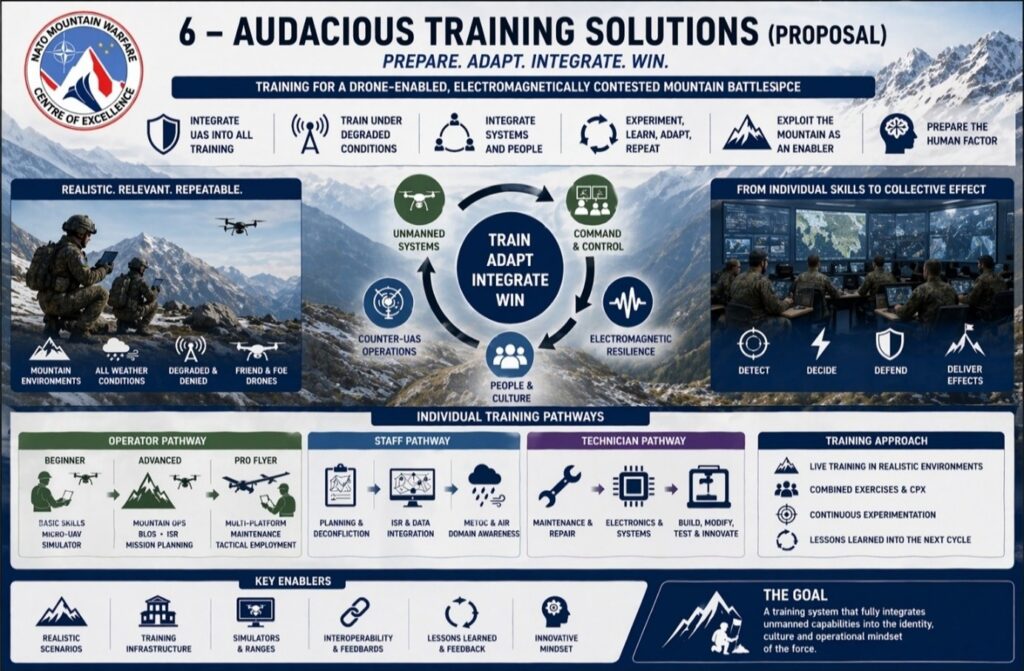
10.2 Collective Training in Mountain Warfare

While individual training builds the necessary competencies, collective training is where these capabilities are integrated, tested, and validated under operational conditions.

ATrainP-6 already provides a robust framework for collective mountain warfare training, emphasizing small-unit autonomy, leadership, and the ability to operate in complex terrain. However, the introduction of unmanned systems and the contested electromagnetic environment require a systematic evolution of how collective training is designed and conducted.

The objective is to move from training units that use drones to units that fight in a drone-saturated battlespace.

10.2.1 Integration of UAS and C-UAS in All Training Activities

A first essential step is the systematic integration of UAS and Counter-UAS across all collective training activities. Unmanned systems should not be introduced as a discrete training inject, but rather treated as a constant element of the operational environment. They must be employed continuously, by both friendly forces and opposing elements, and fully embedded into all tactical problems. This includes ISR support to maneuver, the use of FPV and loitering munitions, and the employment of C-UAS measures, as well as the practical management of low-altitude airspace.

10.2.2 Training Under Degraded and Denied Conditions

Equally important is the need to train under degraded and denied conditions as a baseline, rather than an exception. In addition to the environmental challenges already addressed within ATrainP-6, training scenarios must routinely incorporate GNSS disruption, communications degradation, and electronic warfare effects. This forces units to operate with incomplete or unreliable information, adapt procedures dynamically, and maintain command and control under stress. In doing so, training shifts from reliance on technological enablers to the development of resilient and adaptive behaviour.

10.2.3 Command Post Exercises (CPX) and Data-Centric Training

At company and battalion level, the increasing volume of data generated by unmanned systems requires a stronger focus on command post training and data-centric processes. Collective training must therefore include structured Command Post Exercises (CPX), where commanders and staff are required to manage real-time information flows, prioritize targets, and synchronize ISR, fires, and maneuver. The challenge at this level is no longer access to information, but the ability to process and exploit it effectively under time pressure. Training must deliberately replicate conditions of information overload, conflicting inputs, and compressed decision-making timelines.

10.2.4 Live Exercises (LIVEX) in Drone-Saturated Environments

Live exercises (LIVEX) must also evolve accordingly. Training environments should reflect the realities of modern operations, characterized by the constant presence of drones, both friendly and adversary. This includes realistic exposure to FPV and loitering munition threats, as well as the practical employment of countermeasures. Particular attention should be given to operations conducted in confined valleys, restricted lines of sight, and fragmented terrain compartments, where communication is degraded and coordination becomes more complex. Mountain terrain, in this regard, naturally amplifies both the advantages and the limitations of unmanned systems, making it an ideal environment for realistic training.

10.2.5 Airspace Management and Deconfliction Training

Another critical aspect concerns airspace management and deconfliction at the tactical level. As the density of unmanned systems increases, particularly in mountainous environments with limited vertical separation, the risk of interference and fratricide becomes significant. Collective training must therefore include practical procedures for coordinating multiple systems, deconflicting ISR and strike assets, and integrating unmanned operations with indirect fires. The emphasis should be on simple, scalable solutions and clearly defined responsibilities.

10.2.6 Integration of Logistics and Sustainment

The logistic dimension must also be fully integrated into collective training. Sustaining unmanned operations over time requires more than technical capability; it demands robust processes for resupply, maintenance, and system management. Training scenarios should therefore include the use of cargo drones for resupply, battery rotation and management, field maintenance, and the recovery and reconfiguration of damaged systems. Without this, even advanced capabilities risk degrading rapidly in prolonged operations.

10.2.7 Experimentation and Iterative Learning

Finally, collective training must serve as a platform for continuous experimentation and iterative learning. Units should be encouraged to test new tactics, techniques, and procedures, adapt to evolving threats, and integrate lessons identified into subsequent training cycles. This requires structured feedback mechanisms, rapid dissemination of lessons learned, and a close linkage between training activities and doctrinal development.

10.2.8 Conclusion

The aim is not only to prepare forces for current operations, but to ensure that training itself becomes a driver of adaptation and innovation.

In this context, collective training transforms individual competencies into a coherent operational capability. Units must be able to integrate UAS, Counter-UAS, fires, maneuver, and electromagnetic effects into a unified system, maintain tempo under degraded conditions, and operate effectively in a battlespace defined by uncertainty, saturation, and continuous change.

ATrainP-6 provides the foundation for this process. The challenge is to evolve it into a training system that fully reflects the realities of a modern, drone-enabled mountain battlefield.

11 - The Need to Change Procurement: Dynamic Procedures for Effective Results

11.1 – The Current Procedure

NATO acquires military capabilities through a multi-level procurement system involving national governments, NATO common-funded programmes, and specialized NATO agencies. While most military equipment is purchased directly by member states, NATO coordinates common requirements, interoperability standards, and certain collective acquisitions.

The process begins with the identification and validation of operational requirements, ensuring that proposed capabilities are necessary, feasible, and adequately funded. NATO then conducts market analysis through industry engagement, Requests for Information (RFIs), and research activities to identify available technologies and assess risks and costs.

Procurement is generally carried out through competitive processes to guarantee transparency, fairness, and value for money. Depending on the circumstances, acquisitions may involve open competition, restricted competition, or sole-source contracts when justified by operational or security needs.

Proposals are evaluated based on criteria such as operational effectiveness, technical performance, lifecycle costs, and overall value, rather than solely on the lowest price. After contract award, NATO closely manages programme execution through testing, reviews, acceptance procedures, configuration management, and performance monitoring.

The entire acquisition system is founded on key principles: transparency, competition, interoperability, accountability, and value for money, ensuring that NATO can effectively develop and sustain military capabilities across the Alliance.

However, the increasing pace of technological innovation, particularly in areas such as unmanned systems, autonomous capabilities, artificial intelligence, and counter-UAS technologies, is placing growing pressure on traditional acquisition cycles. Systems that may evolve significantly within months are often introduced through procurement processes designed for capability lifecycles measured in years. As a result, NATO and Allied nations are increasingly exploring more agile approaches, including rapid acquisition initiatives, experimentation campaigns, prototype evaluation, and test-before-buy methodologies. These efforts seek to reduce the gap between technological innovation and operational fielding while maintaining the governance, transparency, and accountability requirements that characterize NATO procurement activities.

11.2 – The Need for Procurement Transformation

Recent conflicts have demonstrated that technological innovation is increasingly occurring at a pace that challenges traditional acquisition timelines. Unmanned systems, electronic warfare tools, software-defined capabilities, artificial intelligence applications, and counter-UAS solutions can evolve substantially within months.

This growing mismatch between the speed of technological change and the speed of acquisition presents a significant challenge for military organizations. In many cases, technologies may already be approaching obsolescence by the time formal procurement processes are completed. Consequently, the ability to adapt operational capabilities rapidly is becoming as important as the capabilities themselves.

The ongoing war in Ukraine provides a particularly relevant example of this phenomenon. Throughout the conflict, innovation has frequently emerged from the tactical level rather than through centralized development programmes. Front-line units have repeatedly identified operational problems, adapted commercially available technologies, modified existing systems, and developed new employment concepts in response to immediate battlefield requirements. Successful solutions have then been observed, validated, and disseminated through higher headquarters based on demonstrated operational effectiveness rather than through lengthy development cycles.

This model represents a significant departure from traditional top-down acquisition approaches. Rather than beginning with a centrally defined requirement and progressing through a structured procurement process, capability development often starts with operational experimentation conducted by the units directly facing the problem. Battlefield effectiveness becomes the primary validation mechanism.

The lessons emerging from Ukraine suggest that future military competitiveness may depend not only on the ability to acquire advanced technologies, but also on the ability to identify useful innovations rapidly, evaluate them under operational conditions, and distribute them across the force at a speed comparable to that of adversaries.

Such an approach would require greater authority at lower command levels, stronger links between operational units and acquisition organizations, simplified mechanisms for limited-scale procurement, and more effective systems for capturing and disseminating lessons learned. Most importantly, it would require a cultural shift in which innovation is not viewed solely as a product of centralized programmes, but also as a process that can emerge from operational units themselves.

The question is no longer whether military organizations can acquire new technologies. The question is whether they can do so at the speed required by contemporary warfare.

12 - Counter-UAS in Mountain Warfare: A Layered Approach

The analysis of the evolving threat, combined with the outcomes of workshops, experimentation, and operational observations, highlights that Counter-UAS in mountain warfare cannot be addressed through a single capability or a centralized solution.

Recent conflicts have demonstrated that adversaries increasingly employ reconnaissance-strike complexes integrating ISR drones, FPV systems, loitering munitions, electronic warfare assets, and digital command-and-control networks. These systems significantly compress sensor-to-shooter timelines, enabling rapid detection, identification, targeting, and engagement cycles. In mountain warfare, where terrain often constrains maneuver into predictable routes and terrain corridors, such capabilities can substantially increase the vulnerability of military forces and challenge traditional approaches to concealment, movement, and force protection.

It must instead be understood and designed, with a particular attention in Mountain Warfare, as a layered, distributed, and terrain-adapted system, where responsibilities are shared across all echelons—from the individual soldier to higher headquarters.

This approach reflects a fundamental consideration: in mountainous environments, terrain, weather, and limited lines of sight degrade both unmanned systems and counter-measures. As a result, effectiveness can only be achieved through redundancy, dispersion, and integration across multiple levels.

12.1 – A proposed five-Layer Model for C-UAS in Mountain Warfare

A coherent and scalable approach can be structured around five complementary layers, each contributing to detection, protection, and engagement in a different way.

The first layer is the Passive Defence Layer, which is embedded across the entire force. This layer does not rely on technology, but on fieldcraft, discipline and training. It includes camouflage, dispersion, concealment, signature management (thermal, visual, and electromagnetic), the use of decoys, and terrain masking. In mountain warfare, this is the first and most effective form of protection, as it directly reduces exposure and limits the number of threats that must be actively countered.

The second layer is the Local Awareness Layer, positioned primarily at company and battalion level. This layer is based on small, distributed elements capable of providing immediate detection, reporting, and local situational awareness. It includes trained observers, passive sensors, and basic C-UAS kits. In mountainous terrain, where engagement timelines are short due to terrain masking, this layer is essential to provide early warning and enable rapid reaction. The training for these assets should be done in Mountain Units/schools.

The third layer is the Battalion Maneuver-Support Layer, which represents the first level of coordinated and structured C-UAS capability. At this level, a dedicated C-UAS platoon or equivalent element integrates detection, limited effectors, and reporting functions. Its role is to protect critical nodes—such as command posts, logistics hubs, artillery positions, landing zones, and key terrain—and to support maneuver units across multiple terrain compartments. It also ensures the integration of information into the battalion-level operational picture.

The fourth layer is the Brigade C-UAS Coordination Layer, typically organized as a company or battery. At this level, the focus shifts from local engagement to coordination, prioritization, and synchronization. This layer is responsible for managing the overall C-UAS picture, allocating resources, integrating detection and engagement systems, and coordinating with fires, electronic warfare, and airspace control. It ensures that limited assets are employed where they are most effective, taking into account terrain and operational priorities.

The fifth layer is the Higher-Echelon Reachback Layer, which provides capabilities that cannot be generated at brigade level. This includes access to wide-area surveillance, advanced intelligence, signals exploitation, long-range communication systems, and higher-level authorization for certain countermeasures. In a mountain context, where local capabilities are often constrained, this layer ensures depth, scalability, and integration within the broader operational framework.

12.2 – Key Considerations

This layered approach reinforces several key principles:

  • C-UAS is not a standalone function, but a system-of-systems problem
  • effectiveness depends on distribution, redundancy, and integration, rather than centralization
  • terrain dictates both threat behaviour and defensive architecture
  • passive measures and field discipline remain the first line of defence

12.3 – Conclusion

In mountain warfare, C-UAS must be organized as a distributed, layered, brigade-led but battalion-embedded capability, fully integrated into the force structure and training system.

It is not sufficient to rely on a limited number of advanced systems. Instead, success depends on the ability to combine simple and scalable solutions, trained personnel at all levels and resilient and adaptable architectures.

Ultimately, the units that will prevail are not those with the most advanced technology, but those able to integrate, adapt, and operate effectively within a complex and contested environment shaped by terrain, weather, and continuous aerial threat.

13 - New Operational Possibilities in Mountain Warfare

13.1 – Cargo UAVs and Mountain Warfare: New prospects for Sustainment and Mobility

Among the many applications of unmanned systems, Cargo UAVs (Cargo Unmanned Aerial Vehicles) represent one of the capabilities with the highest transformational potential for mountain operations. While much of the doctrinal and public attention is focused on ISR drones, FPV systems, and strike platforms, the use of unmanned aerial systems for logistical transport may have an equally significant impact on the operational effectiveness of mountain units.

Historically, logistics has been one of the principal limiting factors in mountain warfare. Difficult access, steep terrain, limited infrastructure, vulnerable supply routes, and rapidly changing weather conditions have consistently imposed significant constraints on mobility and sustainment operations.

In this context, Cargo UAVs should not be viewed merely as a technological alternative to traditional means of transport. Rather, they represent a capability capable of creating entirely new operational possibilities. By reducing dependence on ground lines of communication, minimizing personnel exposure, increasing the frequency of resupply missions, and supporting isolated units in otherwise inaccessible areas, Cargo UAVs have the potential to fundamentally reshape military logistics in mountainous terrain.

Recent experimentation conducted by the NATO MW COE during the NATO EXE Triglav Star has demonstrated that cargo UAVs are capable to reduce the impact of logistic operations of 90%, in terms of time (time to resupply from hours to minutes) and personnel need to transport materials/resupply.

The most significant aspect of Cargo UAVs is not simply their ability to replace existing logistical platforms, but their potential to create entirely new operational options. In this chapter we will just examine some ideas come out from our workshops/studies.

Cargo UAVs enable the simultaneous support of multiple small and dispersed units across the battlespace. Instead of concentrating logistics along a limited number of vulnerable supply routes, sustainment can be distributed through numerous independent aerial connections.

This supports the broader trend toward distributed operations and decentralized force employment and will bring to a big reduction in logistic vulnerability. It is a matter of facts that logistical operations have traditionally represented one of the most vulnerable aspects of military activity. The employment of Cargo UAVs reduces personnel exposure, dependence on ground convoys, vulnerability of supply routes and reliance on manned helicopter missions.

This is particularly important in environments characterized by persistent observation and rapid targeting cycles.

Another important aspect is the concept of point-to-point logistics. Micro-UAVs with limited payload capacity can be employed as individual delivery systems, providing direct resupply to a single soldier. In other words, logistics can be tailored to the immediate needs of an individual on the battlefield, delivering the right resources at the right time and place.

This represents a fundamental shift in the traditional logistics paradigm and should be considered in the design of future Battle Management Systems (BMS) for tactical units.

In Mountain Warfare, point-to-point resupply (support to distributed operation in a compartmented terrain) has the potential to be a true game changer. It could enable small teams to operate independently for extended periods in remote and inaccessible terrain, reducing their logistical footprint while significantly increasing endurance, flexibility, and operational reach.

In this context of point-to-point logistics enabled by UAVs, medical support can be fundamentally redesigned, allowing critical supplies such as blood products, medications, medical equipment, and even diagnostic tools to be delivered directly to the point of need. This capability has the potential to reduce treatment delays, extend the reach of medical support in austere and remote environments, and significantly improve casualty survivability, particularly in Mountain Warfare operations where traditional evacuation and resupply routes may be limited or unavailable.

The emergence of UAV-enabled soldier-centric logistics represents a paradigm shift from unit-based resupply to individualized sustainment, where supplies are delivered directly to the soldier based on real-time operational needs.

Cargo UAVs are likely to represent one of the most transformative capabilities for mountain warfare over the coming decade. While they are unlikely to completely replace helicopters or ground vehicles, they offer the potential to create a more resilient, distributed, and less vulnerable logistical network. In particular, the combination of multirotor systems for short-range tactical sustainment and long-range VTOL platforms for operational-level logistics could fundamentally alter the way mountain units are supplied, sustained, and supported during operations.

In this sense, Cargo UAVs should not be regarded simply as a new logistical platform. They should be understood as enablers of new operational concepts, directly contributing to mobility, survivability, operational endurance, and freedom of maneuver in some of the most challenging environments faced by modern military forces.

13.2. Environmental Intelligence in Snow- and Ice-Dominated Environments

One of the least explored yet potentially most transformative applications of unmanned systems in mountain and Arctic warfare is their ability to generate detailed environmental intelligence regarding snow- and ice-covered terrain. While UAVs are commonly associated with reconnaissance, surveillance, targeting, and strike missions, recent technological developments demonstrate that they can also function as advanced terrain intelligence platforms capable of providing information that directly influences mobility, survivability, sustainment, force protection, and operational planning.

This capability is particularly relevant in northern and mountainous regions, where snow and ice are not merely environmental features but operational variables that can significantly affect the conduct of military operations. In such environments, understanding terrain conditions often determines where forces can move, how they can be sustained, which routes can be used safely, and whether specific operations are feasible at all.

Countries with extensive Arctic and sub-Arctic territories—including Norway, Sweden, Finland, Canada, Greenland, and the United States (Alaska)—have increasingly employed UAV systems to monitor snowpacks, glaciers, frozen lakes, rivers, sea ice, and ice-covered fjords. Initially developed for scientific, meteorological, hydrological, and environmental applications, many of these technologies are now attracting growing military interest due to their ability to support operational decision-making in extreme environments.

Traditionally, the assessment of snow and ice conditions relied on field surveys, manual probing, drilling operations, snow pits, specialized vehicles, and personnel operating directly within potentially hazardous terrain. Although these methods remain valuable, they are labour-intensive, geographically limited, time-consuming, and often expose personnel to unnecessary risk.

Unmanned systems offer a fundamentally different approach. Rather than collecting information at isolated points, UAVs can generate high-resolution, large-area assessments capable of providing near real-time understanding of environmental conditions across entire operational sectors.

13.2.1 – Lessons from the Siege of Leningrad

The logistical operations conducted across the frozen surface of Lake Ladoga during the Siege of Leningrad (1941–1944) represent an early example of environmental intelligence applied to sustainment and mobility in extreme climatic conditions. Although the concept of Environmental Intelligence (EI) had not yet been formally developed, Soviet forces relied extensively on the continuous collection, interpretation, and operational exploitation of environmental data to maintain the so-called “Road of Life,” the only viable supply route connecting the besieged city with Soviet-controlled territory.

Engineers and military personnel conducted regular measurements of ice thickness along potential routes, recognizing that the mere presence of ice did not guarantee sufficient load-bearing capacity. Particular attention was paid to local variations in ice strength, hidden fractures, and areas affected by snow accumulation or changing environmental conditions. Route selection was therefore based on continuous assessment rather than on fixed geographical considerations. As a result, the safest route was often not the shortest one, and supply corridors were repeatedly modified in response to evolving environmental conditions.

The Lake Ladoga operation demonstrates how environmental observation can become a decisive enabler of military mobility and sustainment in cold-weather environments. Continuous monitoring, route optimization, adaptive planning, phased reconnaissance, and the integration of environmental data into decision-making processes allowed Soviet forces to maintain a critical logistical lifeline under exceptionally challenging conditions. These principles remain relevant today and provide a historical precedent for modern applications of environmental intelligence in cold-weather, Arctic, and mountain warfare operations.

13.2.2 – Snow and Ice Assessment Capabilities: a new approach to Research and Development

Modern UAV systems can support the monitoring and assessment of:

  • sea, lake, river, and fjord ice thickness;
  • seasonal ice formation and degradation;
  • snow depth and snow distribution;
  • snowpack density and internal structure;
  • snow water equivalent (SWE);
  • wind-driven snow accumulation patterns;
  • avalanche-prone terrain;
  • crevasses, cavities, and weak layers;
  • trafficability of frozen routes;
  • snow and ice bearing capacity;
  • mobility corridors for personnel and vehicles;
  • environmental hazards affecting military operations.

These capabilities become particularly valuable in mountain and Arctic environments where terrain conditions can change rapidly and where inaccurate assessments may directly affect operational effectiveness and force protection. If there are no such capabilities, Mountain Troops should dedicate resources for Research and Development. This highlighted once again the critical importance of a close cooperation among military forces and civilian company in the development of tailored product. We need to change this paradigm too.

13.2.3 – Military Relevance and New Operational Possibilities

From a military perspective, these developments represent far more than an improvement in environmental monitoring.

They illustrate how unmanned systems are expanding the concept of intelligence itself.

Traditionally, snow and ice were treated primarily as environmental constraints that had to be assessed through direct observation and field measurements. UAV-enabled environmental intelligence transforms them into measurable, mappable, and continuously monitored operational variables.

This creates entirely new operational possibilities. Commanders may increasingly gain access to near real-time information regarding:

  • terrain trafficability;
  • avalanche risk;
  • frozen-route viability;
  • snow and ice bearing capacity;
  • environmental hazards;
  • mobility corridors;
  • sustainment routes;
  • route optimization opportunities.

Such information can directly influence maneuver planning, force protection, sustainment operations, reconnaissance activities, and operational decision-making.

In mountain and Arctic warfare, where environmental conditions frequently determine the feasibility of military operations, this capability represents a significant shift. Mountain Troops should invest and innovate more on such technologies.

Rather than simply improving existing reconnaissance processes, unmanned systems are enabling a new form of terrain intelligence in which snow and ice become continuously monitored operational variables. This development expands situational awareness beyond the enemy and toward the environment itself, creating new opportunities for mobility, survivability, sustainment, and operational effectiveness in some of the most demanding environments on Earth.

14 - Final conclusion

14.1 – Cooperation, Experimentation and Innovation

An additional conclusion emerging from this study is the importance of maintaining continuous cooperation between military organizations, industry partners, civilian research institutions, and partner nations. The pace of technological innovation in the unmanned systems domain significantly exceeds traditional military acquisition and doctrinal adaptation cycles. As a result, future capability development cannot rely solely on internal military processes.

Close cooperation with industry and research institutions should therefore remain an essential component of future mountain warfare capability development. Such cooperation enables the rapid identification of emerging technologies, facilitates operational experimentation, and supports the continuous adaptation of doctrine, training, and operational procedures.

Particular relevance has been identified in areas including ISR platforms, FPV technologies, cargo drones, autonomous support systems, resilient communication solutions, artificial intelligence applications, and Counter-UAS capabilities. These technologies are evolving rapidly and will continue to influence how mountain forces operate, sustain themselves, and generate combat effects in complex terrain.

Experimentation must remain a central activity within this process. Future experimentation programs should focus on operationally relevant capability areas directly connected to mountain warfare requirements.

Mountain warfare experimentation requires dedicated training areas where operators, units, and innovators can continuously test, challenge, and refine new technologies and TTPs under realistic conditions. These facilities should not be purely military environments, but collaborative innovation hubs bringing together military units, mountain rescue organizations, academia, and industry partners specialized in mountain technologies, robotics, autonomous systems, communications, and mobility. Such a model would create a mutually beneficial ecosystem in which operational users provide real-world feedback, rescue organizations contribute unique expertise gained in extreme environments, and industry gains direct access to realistic testing conditions. Innovation cannot be imposed from above alone. Without a strong bottom-up experimentation culture and continuous interaction among military, civilian, and industrial stakeholders, mountain forces risk adapting to change only after others have shaped it—becoming followers rather than leaders in the future battlespace.

The objective of experimentation should not be limited to evaluating individual platforms or technologies. Rather, it should focus on developing a deeper operational understanding of how unmanned and autonomous capabilities can be effectively integrated into future mountain warfare operations and force structures.

14.2 – The Role of the MW COE and the NATO Community of Interest

The findings of this study further reinforce the importance of maintaining a multinational framework for experimentation, operational assessment, interoperability development, and knowledge exchange.

In this context, the NATO Mountain Warfare Centre of Excellence is uniquely positioned to serve as a platform for multinational cooperation, experimentation, doctrinal adaptation, and capability development. By bringing together military practitioners, subject matter experts, industry representatives, researchers, mountain rescue organizations, academic institutions, and partner nations, the MW COE can contribute to the identification, validation, and dissemination of lessons relevant not only to mountain warfare, but also to the broader transformation of NATO forces.

The continued development of a Mountain Unmanned Systems Experimentation Framework would provide significant benefits to participating nations, partner nations, NATO entities, and the wider Mountain Warfare Community of Interest. Such an initiative would support interoperability, accelerate learning, facilitate capability development, and generate operationally grounded observations under realistic mountain warfare conditions.

These environments should function as true mountain innovation ecosystems, enabling continuous interaction between operational users and technology developers. Such collaboration would generate mutual benefits: military organizations would gain access to innovative solutions and rapid feedback cycles, industry would benefit from realistic operational testing, and civilian organizations would gain exposure to emerging technologies applicable to rescue and emergency response operations.

Equally important, the observations, lessons identified, and recommendations generated through studies, workshops, operational assessments, exercises, and experimentation activities should be systematically incorporated into the Mountain Warfare Concept, and should contribute directly to the continuous evolution of ATrainP-6 and future NATO mountain warfare doctrine (ATP 3.2.1.3), ensuring that lessons learned are transformed into lessons applied.

15 - Looking Beyond: A Special Insight Drones and the psyche: conditioning and consequences on military operations

15.1 Introduction

The widespread adoption of Unmanned Aerial Systems (UAS) has fundamentally transformed the modern battlefield. While much attention has been devoted to their tactical, operational and logistical implications, increasing evidence suggests that their psychological effects may prove equally significant. Recent developments in Ukraine, the South Caucasus and the Middle East indicate that drones are not merely changing how wars are fought but also how combatants perceive, experience and psychologically process warfare.

Contrary to early assumptions, the introduction of unmanned technologies has not reduced the psychological burden of combat. Rather, it has altered its nature, generating new forms of stress, moral pressure and cognitive fatigue that affect both drone operators and personnel exposed to persistent drone threats.

15.2 Psychological Effects on Drone Operators

Drone operators often observe targets continuously over extended periods, acquiring detailed knowledge of their routines, movements and social interactions. This prolonged surveillance creates an unusual form of psychological proximity in which the operator develops a level of familiarity with individuals who may later become targets.

Following engagement, operators frequently conduct battle damage assessments and observe the direct consequences of their actions in real time. This exposure can contribute to forms of psychological distress that differ from conventional combat trauma.

A growing body of literature identifies Moral Injury as one of the most relevant phenomena associated with drone operations. Moral injury refers to the psychological, emotional and ethical consequences that arise when an individual perceives that they have violated, or contributed to the violation of, deeply held moral beliefs. Unlike Post-Traumatic Stress Disorder (PTSD), which is primarily associated with fear-based responses, moral injury is linked to guilt, shame, ethical conflict and existential questioning.

In addition, drone operators frequently experience high levels of occupational stress resulting from:

  • extended surveillance missions;
  • sustained concentration requirements;
  • continuous decision-making responsibilities;
  • exposure to graphic imagery;
  • rapid transition between combat operations and civilian environments.

The latter factor is particularly significant. Unlike conventional combat personnel, drone operators may participate in lethal operations during their work shift and return to family life within hours. This abrupt shift between operational and civilian contexts has been identified as a potential contributor to psychological strain and burnout.

15.3 The Emergence of “Drone Anxiety”

While considerable attention has been devoted to drone operators, recent conflicts have highlighted an equally important phenomenon affecting personnel on the ground: the emergence of what many analysts informally describe as Drone Anxiety.

Historically, soldiers were accustomed to identifying threats originating from relatively predictable directions and locations. Modern drones fundamentally alter this perception. The threat becomes omnidirectional, persistent and often invisible.

Personnel operating in drone-saturated environments understand that they may be continuously observed, tracked over extended periods and targeted without warning.

As a result, the battlefield is increasingly characterised by a perception of permanent exposure.

15.4 Hypervigilance and Persistent Surveillance Stress

One of the most frequently observed effects is the development of chronic hypervigilance.

In conventional combat, periods of intense alertness are generally interspersed with opportunities for psychological recovery. In contrast, the persistent presence of drones creates the perception that surveillance may occur at any moment. Many soldiers report developing an almost automatic tendency to scan the sky continuously, even during periods of relative safety.

This phenomenon is increasingly associated with what some researchers describe as Persistent Surveillance Stress, a condition resulting from the continuous expectation of observation and targeting.

15.5 Uncertainty and Perceived Vulnerability

A particularly significant psychological factor is uncertainty. Unlike artillery fire or direct enemy contact, drone threats are often ambiguous. Soldiers may hear a drone without seeing it, observe a drone without knowing its purpose, or suspect surveillance without confirmation.

This ambiguity increases stress levels because it deprives personnel of the ability to accurately assess risk and select appropriate responses.

From a psychological perspective, uncertainty often generates greater stress than a clearly identifiable threat. The inability to determine whether one has been detected, tracked or targeted creates a persistent state of cognitive tension.

15.6 Learned Helplessness and Operational Behaviour

Several analysts have identified parallels between drone exposure and the psychological concept of learned helplessness.

When personnel perceive that surveillance is continuous and detection may lead rapidly to engagement, they may gradually develop a sense of reduced control over their environment. For a mountain soldier this sense will be amplified by an environment that it is difficult by nature.

15.7 Implications for Mountain Warfare

Mountain Warfare presents unique conditions that may amplify many of the psychological effects associated with unmanned systems.

Historically, mountainous terrain provided numerous psychological and tactical advantages, including, like, for example, concealment, terrain masking, restricted observation and opportunities for disengagement.

The increasing availability of advanced UAS equipped with electro-optical, thermal and multispectral sensors is progressively eroding these advantages. Personnel move through valleys, ridgelines, passes and narrow mobility corridors that can be systematically monitored by aerial surveillance assets.

Consequently, soldiers may experience a growing perception that traditional terrain protection can no longer be relied upon. This may contribute to elevated levels of stress, reduced confidence in concealment measures and increased hesitation during manoeuvre operations.

For Mountain Warfare forces, the psychological dimension of drone proliferation may therefore become as significant as its kinetic effects.

References

  • NATO Standardization Office (NSO), ATrainP-6 u2013 NATO Education and Training for Mountain Warfare, latest edition.
  • NATO Standardization Office (NSO), ATP 3.2.1.3 u2013 NATO Conduct of tactical operations in mountainous environment, latest edition.
  • NATO Allied Command Transformation (ACT), Emerging and Disruptive Technologies in the Military Domain, various reports.
  • NATO, Counter-Unmanned Aircraft Systems (C-UAS) Conceptual Frameworks and Experimentation Activities, including recent testing initiatives in Latvia.
  • Joint Analysis, Training and Education Centre (JATEC), Operational Observations from the War in Ukraine, selected reports and studies.
  • Joint Air Power Competence Centre (JAPCC), Countering Unmanned Aerial Systems (C-UAS): Towards a Comprehensive Approach, various publications.
  • Center for a New American Security (CNAS), Countering the Swarm: Strategy and Capabilities in the Age of Drone Warfare.
  • U.S. Army Combined Arms Center / Army University Press, Military Review, u201cThe Unmanned Aircraft Revolution,u201d Julyu2013August 2025.
  • U.S. Army War College, War Room, u201cTransforming for Drone Warfare,u201d selected articles.
  • U.S. Army, Drone Dominance Initiative, official publications and operational insights.
  • Modern War Institute (West Point), u201cWant Drone Dominance? Let the Squad Fail.u201d
  • Military.com, u201cHow Ukraineu2019s Drone War Is Forcing the U.S. Army to Rewrite Its Doctrine.u201d
  • Breaking Defense, u201cFrozen Drones and Robotic Mules: Lessons Learned from U.S. Army Exercises in Europe.u201d
  • Defense One, Against the Drones, special coverage and analysis.
  • Royal Air Force, u201cLayered Defence: Countering Drone Threats in a Multi-Domain Environment.u201d
  • DroneLife, u201cCounter-Drone Systems Moving from Experiments to Infrastructure,u201d 2026.
  • CBS News, u201cDrone Warfare and Its Impact on Modern Conflicts,u201d analysis on Ukraine and Europe.
  • CNN, u201cThe Rise of Military Drone Warfare in Modern Conflicts,u201d 2025.
  • NATO Mountain Warfare Centre of Excellence (MWCOE), Workshop Proceedings and Internal After Action Reviews (AARs).
  • NATO Mountain Warfare Centre of Excellence (MWCOE), Operational Feedback Observations (OFO).

Contributing Experts and Workshop Participants

The development of this study was supported by the valuable contributions of subject matter experts and practitioners who participated in the Mountain Warfare Workshop in Polje, Slovenia in march 2026.

Their inputs, insights, and operational experience have been instrumental in shaping the analysis and proposals presented in this document.

A special acknowledgement is extended to: