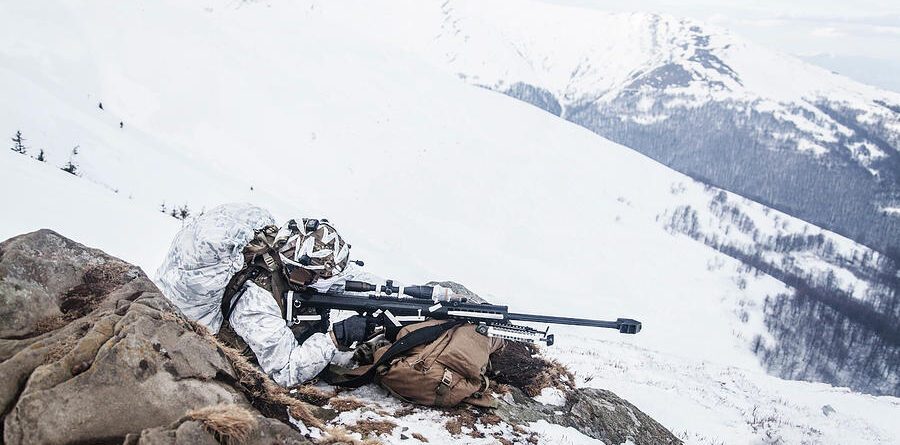
Mountain warfare presents one of the most challenging environments for military snipers. Engagements frequently occur at long distances and under rapidly changing environmental conditions. Altitude and reduced air density significantly affect bullet trajectory and ballistic performance, requiring snipers to apply advanced ballistic calculations and to understand the effects of environmental variables on their weapon systems.
Likewise, steep firing angles—both uphill and downhill—can dramatically influence the point of impact and demand specialised knowledge and training. The complex wind patterns typically encountered in mountain valleys, ridgelines, passes, and narrow defiles create additional challenges for accurate shot placement. Winds can vary considerably within short distances, requiring a high degree of experience and environmental awareness.
Furthermore, the employment of snipers in mountainous terrain requires a thorough understanding of mobility constraints, altitude-related physiological effects, and sustainment considerations. These factors make the mountain sniper a highly specialised capability whose effectiveness depends upon dedicated training, the continuous exchange of expertise, and the development of common procedures among allied and partner nations.
The planned Military Sniper Workshop in the Czech Republic, with its focus on technical and tactical aspects of engagements involving ballistic glass, offers an excellent opportunity to address one specific area of sniper expertise while simultaneously strengthening the wider professional network of military sniper communities. The sharing of experiences and the development of common approaches will contribute directly to improving interoperability and enhancing operational effectiveness.
The NATO Mountain Warfare Centre of Excellence therefore strongly supports the establishment of the Military Sniper Working Group and considers it fully aligned with the Centre’s mission to promote excellence, interoperability, and the continuous development of capabilities required to operate successfully in mountainous environments.
In an era characterised by increasingly complex operational challenges, initiatives such as the MSWG are essential to ensuring that NATO and partner nations maintain highly capable, adaptable, and interoperable sniper forces, fully prepared to operate in some of the world’s most demanding terrain.