TAROKETTO
Italian Front (WW1)
World War I broke out in 1914 due to a combination of long-term tensions and immediate triggers. One major cause was militarism, as European powers engaged in an arms race and built massive armies and navies, making war more likely. Alliances also played a crucial role, with countries bound together in defensive pacts such as the Triple Alliance (Germany, Austria-Hungary, and Italy) and the Triple Entente (France, Russia, and Britain), which meant that a conflict between two states could quickly escalate into a global war. Nationalism added further fuel, as different ethnic groups sought independence and rival nations pursued power and prestige. Imperialism increased rivalry as European countries competed fiercely for colonies and resources around the world. Finally, the immediate spark came with the assassination of Archduke Franz Ferdinand of Austria-Hungary in June 1914, which set off a chain of diplomatic crises and declarations of war. Together, these factors created a volatile situation that erupted into the first global conflict.
Austria-Hungary military war plans
Austria-Hungary had two main pre-WWI war plans: Plan B, focused on a primary invasion of Serbia with defensive actions against Russia, and Plan R (the one implemented in 1914), which emphasized a much stronger offensive against Russia in Galicia, with a reduced but still significant force against Serbia, anticipating a slow Russian mobilization but also a German offensive. The primary goal for attacking Serbia was to destroy the perceived threat of a Russian-inspired Balkan league and secure dominance in Southeastern Europe.
Austria-Hungary did not have specific offensive “O-War Plans” against Italy. Instead, it developed a defensive strategy to hold the Italian border, anticipating an attack after Italy left the Triple Alliance and joined the Entente.
As a result, the Austro-Hungarians were forced to move some of their forces from the Eastern Front, and a war in the mountains around the Isonzo River began
Italian military war plans
In April 1915, in the secret Treaty of London, Italy was promised by the Allies some of the territories of the Austro-Hungarian Empire, which were mainly inhabited by ethnic Slovenes, Croats and Austrian Germans.
Italian commander Luigi Cadorna, a staunch proponent of the frontal assault who claimed the Western Front proved the ineffectiveness of machine guns, initially planned to break onto the Slovenian plateau, taking Ljubljana and threatening Vienna. The area between the northernmost part of the Adriatic Sea and the sources of the Isonzo River thus became the scene of twelve successive battles.
With the rest of the mountainous 640-kilometre length of the front being almost everywhere dominated by Austro-Hungarian forces, the Soča (Isonzo) was the only practical area for Italian military operations during the war. The Austro-Hungarians had fortified the mountains ahead of the Italians’ entry into the war on 23 May 1915.
Italian Chief of Staff Luigi Cadorna judged that Italian gains (from Gorizia to Trieste) were most feasible at the coastal plain east of the lower end of the Soča (Isonzo) River. Cadorna had not expected operations in the Isonzo sector to be easy. He was well aware that the river was prone to flooding—and indeed there were record rainfalls during 1914–1918. Further, when attacking further north, the Italian army was faced with something of a dilemma: to cross the Isonzo safely, it needed to neutralise the Austro-Hungarian defenders on the mountains above, yet to counteract these forces, the Italian troops first needed to cross the river.
12 Battles of the Isonzo
The Battles of the Isonzo (also known as the Isonzo Front by historians, or the Soča Front –Slovene: soška fronta) were a series of twelve battles between the Austro-Hungarian and Italian armies in World War I, mainly on the territory of present-day Slovenia, and the remainder in Italy along the Isonzo River on the eastern sector of the Italian Front between June 1915 and November 1917.
Italian troops did not reach the port of Trieste, the Italian General Luigi Cadorna’s initial target, until after the Armistice.
The Twelfth Battle of the Isonzo, better known as the Battle of Caporetto, took place from 24 October to 12 November 1917 and marked one of the most catastrophic defeats for the Italian Army during the First World War. German and Austro-Hungarian forces launched a massive offensive near the town of Caporetto (today Kobarid, Slovenia), employing new infiltration tactics, heavy artillery, and poison gas. The Italian lines quickly collapsed, leading to a chaotic retreat of over 100 kilometers to the Piave River. The disaster resulted in around 10,000 Italian soldiers killed, 30,000 wounded, and more than 250,000 taken prisoner, with hundreds of thousands more deserting or dispersing. Beyond the staggering losses, Caporetto had profound consequences for Italy’s morale and political stability, prompting the dismissal of General Luigi Cadorna and nearly bringing Italy to the brink of surrender. It has since become a symbol of military disaster and disorganization, remembered as a turning point in the Italian Front of the war.
The Battle of Vittorio Veneto, for our game purpose known as the 13th Isonzo Battle, was fought from 24 October to 3 November 1918 (with an armistice taking effect 24 hours later) near Vittorio Veneto on the Italian Front during World War I. The Royal Italian Army launched a counter-offensive: the Italian victory marked the end of the war on the Italian Front, secured the dissolution of the Austro-Hungarian Empire and contributed to the end of the First World War just one week later
Casualties
Despite the considerable effort and resources poured into the continuing Isonzo struggle, the results were invariably disappointing and without real tactical merit, particularly given the geographical difficulties that were inherent in the campaign.
Cumulative casualties of the numerous battles of the Isonzo were enormous. Half of the entire Italian war death total — some 300,000 of 600,000 — were suffered along the Isonzo River. Austro-Hungarian losses, while by no means as numerous, were nevertheless high at around 200,000 (of an overall total of around 1.2 million casualties).
More than 30,000 casualties were ethnic Slovenes, who at the time were citizens of Austria and thus, the majority of them served in the Austro-Hungarian Army. At the same time, Slovene civilian inhabitants from the Gorizia and Gradisca region also suffered in many thousands because they were resettled in refugee camps, where Slovene refugees were treated as state enemies in Italian refugee camps, where thousands died of malnutrition.
Influenza and hunger during World War I had a profound impact on morale and ultimately on the outcome of the war. The 1918 influenza pandemic swept through military camps and civilian populations, killing millions—including young, fit soldiers—at a rate that no weapon could match. This not only weakened armies physically but also shattered morale as soldiers and civilians alike saw death strike without warning. Hunger, especially severe in Germany and Austria-Hungary due to Allied blockades and collapsing agriculture, led to widespread malnutrition, declining worker productivity, and unrest on the home front. Food riots, strikes, and civilian despair undermined the will to continue fighting.
Summary of the Italian front WW1 – Isonzo battles | ||||
Battle | Dates | Italian casualties | Austro-Hungarian casualties | Outcome |
23 June – 7 July 1915 | 15,000 | 10,000 | Inconclusive | |
18 July – 3 August 1915 | 41,800 | 46,600 | Italian victory | |
18 October – 3 November 1915 | 66,998 | 41,847 | Austro-Hungarian victory | |
10 November – 2 December 1915 | 49,500 | 32,100 | Italian victory | |
9–15 March 1916 | 1,882 | 1,985 | Inconclusive | |
6–17 August 1916 | 51,000 | 42,000 | Italian victory | |
14–18 September 1916 | 17,000 | 15,000 | Italian victory | |
10 October 1916 – 12 October 1916 | 55,000 | 38,000 | Inconclusive | |
31 October – 4 November 1916 | 39,000 | 33,000 | Austro-Hungarian victory, Italian advance halted | |
10 May – 8 June 1917 | 150,000 | 75,000 | Limited Italian advance | |
18 August – 12 September 1917 | 158,000 | 115,000 | Italian victory | |
24 October – 19 November 1917 | 305,000 | 70,000 | Austro-Hungarian-German victory; end of the Isonzo Campaign | |
Tarok and History
“All quiet on Tarok Front”
Tarot games are card games played with tarot packs designed for card play and which have a permanent trump suit alongside the usual four card suits. Tarot games are increasingly popular in Europe, especially in France, where French tarot is the second most popular card game after Belote. In Austria, Tarock games, especially Königrufen, have become widespread, and there are several major national and international tournaments each year. Italy, the home of tarot, remains a stronghold. Games of the tarot family are also played in Hungary, Slovenia, Liechtenstein, Czechia, Slovakia, Switzerland, Denmark, South Germany and South Poland.
General Overview
Tarok is played in groups of either three or four players. The Italian front Tarok is Tarok for four, known as Calling the King. When the number of players at a table is not divisible by
Introduction
Taroketto is a variant of the classic Italian-Austro-Hungarian card game Tarok, simulating the pressure, morale, and tactical feints of the 1917 Italian Front. Each player commands a “faction” and pursues victory through clever bidding, morale manipulation, and bold card play over a series of rounds. The Tarok Military Operational level standard is Tarok for four, known as Calling the King.
I – Visual Representation of Cards
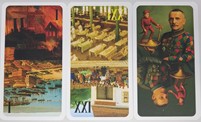
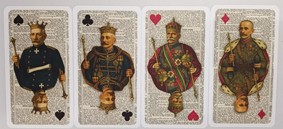
This expanded presentation of the Taroketto deck deepens the narrative identity of each suit and character, establishing a thematic and historical connection with World War I. Cards are not merely game tools but narrative vessels, evoking the spirit of the era and its key locations, formations, stratagems, and figures — military leaders, volunteers, and soldiers from Germany, Austria-Hungary, Italy, France, and the UK. Each card has a thematic role connected to a military operational level or operational art. Card effects include morale shifts, historical events, special declarations, and tactical twists.
II -Visual Style and Game Mechanics
These historical characters have both aesthetic and gameplay value. Card illustrations depict authentic uniforms, insignia, landscapes, and symbols reflective of each person’s battlefield role and contribution. Each image features a caption summarising the character’s background, in-game role, and tactical influence. A printed companion set includes strategy notes and historical context for learning and engagement.
III – Game Structure – Core Rules and Historical Implementation
Taroketto is based on Slovenian Tarok rules with added Isonzo Campaign mechanics.
IV- Victory Points
A Victory Points system represents morale:
- All scores above are added to the game’s Moral points, plus any point difference above 35 collected in tricks.
- All declarations and games can be countered, re-countered, doubling values each time.
- Only the declarer may re-counter.
V – Components
- Standard 54-card Tarok deck.
- Victory Point (VP) represent: Moral points.
- Event cards (optional, see XII).
- Scorepad for tracking points and morale.
VI – Setup
- Each player starts with zero morale on the morale track.
- Each player is dealt a full hand (in a 3-player game: 18 cards each; discard 6 to the Talon).
VII – Sequence of Play
Each Game Turn consists of:
- Operational Foresight, Cards dealing Phase.
- Battle planning: Players bid for declarer.
Lack of Initiative at Battlefield – Klop
- Battle preparations; Reinforcement: Talon cards change
- Battle execution: Play Taroketto tricks.
- Battle assessment Phase:
- Determine the Battle winner.
- Apply VP changes.
VIII – Victory Conditions
- After 12 rounds/battles, the player with higher Victory Points
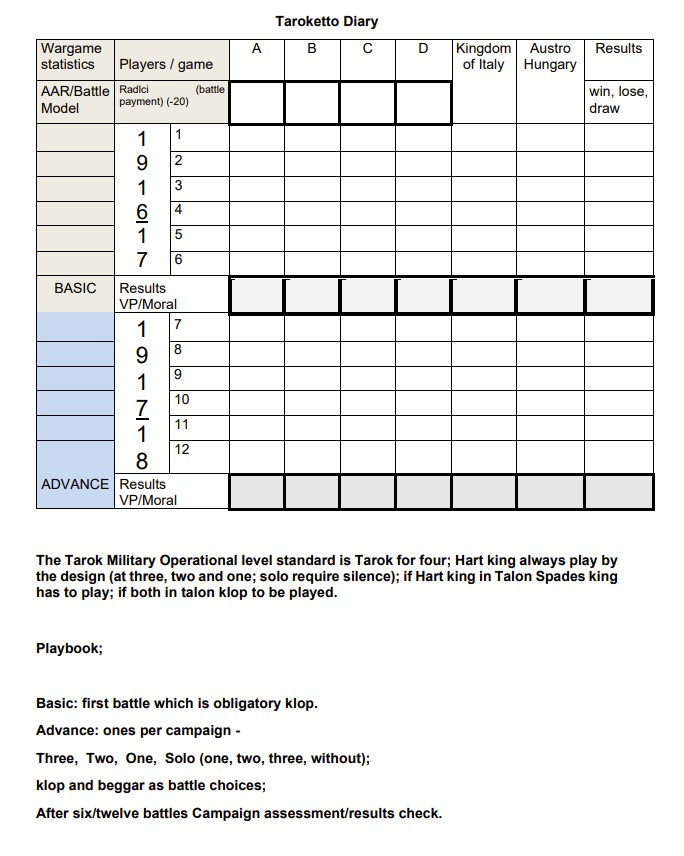
- Non-Used Radlc is counted (– 20 VP).
- Alternatively, if there is a Valat (Suits or Full), it is a Sudden Death Victory. The campaign immediately ends; no 12 battles in Campaign.
IX – Options
(After talon exchange (if applicable), players may declare the following)
- Pagat Ultimo (Trieste/Venice Raid): A player may announce a “raid” before a trick. If they win raid with Pagat, they gain 10 VP for silent raid and 20VP for announced raid.
- Kings (Peace Making): All four kings in tricks.
- Trula (Resilience Testing): Pagat, Mond, and Skis in tricks.
- Silent Declarations: All of the above can be achieved silently for half points.
X – Designer’s Notes
This variant was created to echo the high-stakes, morale-driven warfare of the Italian Front Isonzo Campaign while preserving the core trick-taking mechanic of Tarok. It must be played over a series of 12 rounds, with VP serving as a morale point tracked throughout.
XI – Rules of Engagement (ROE)
Taroketto rules mechanics from the Isonzo Campaign, creating a unique experience (tactical level standard tarock battles; operational level battles with consequences on strategic level; strategic level battles play only for coalitions) play where each round symbolises one of the 12 Battles of the Isonzo.
The Tarok Military Operational level standard is Tarok for four and Playbook;
Basic 1915 and 1916 battles:
- First battle which is obligatory klop.
- Hart king in Basic part of Campaign (1st six battles) declare themselves to other players and play by the game rules design; if Hart king in Talon Spades king has to play; if both in talon klop to be played.
- After fifth battles Campaign assessment/results check in order to foster play for victory in six battle.
Advance 1917 and 1918 battles:
- Players must take higher risk and play only ones per campaign – Three, Two, One, Solo (one, two, three, without.
- Klop and beggar as battle choices.
- No Hart king player discovery.
- After twelve battles Campaign assessment/results operational Campaign for players and Strategic Campaign for coalition.
The Tarok Strategic Campaign level standard is Tarok for four;
- Players decide before Campaign which side will play (Allies – Italy or Central – AO).
- No scores for individual players (A, B, C, D).
- In Basic part First battle which is obligatory klop.
XII – Battle Values