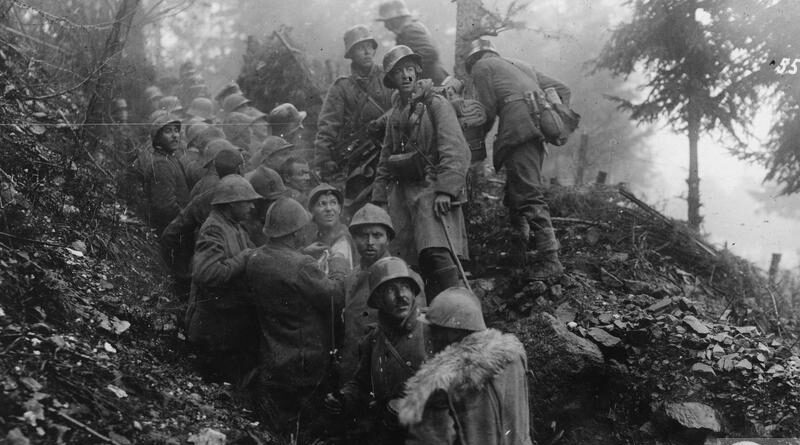
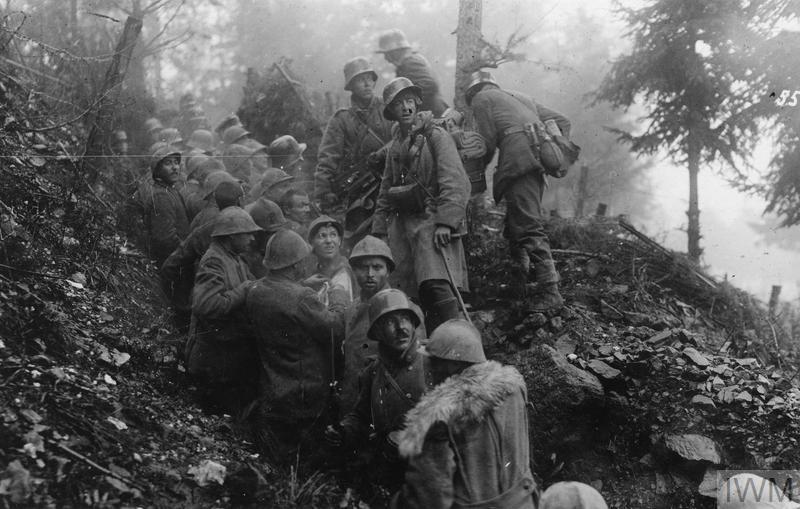
The Battle of Caporetto (today the Slovenian town of Kobarid, which resumed its original name after 1945) is one of those events that has profoundly shaped collective memory.
As might be expected, this transformation had a far greater impact on the nation that suffered defeat. It is therefore no coincidence that, in Italian, the expression “It was a Caporetto” is still commonly used to describe a disastrous and unexpected failure—one so overwhelming that recovery appears almost impossible.
This meaning originated precisely from the profound impression that the events of October 1917 left on Italian public opinion.
Without dwelling on the broader strategic background, it is well known that the battle must be understood within the context of the eleven Italian offensives launched along the Isonzo River with the objective of breaking through the Austro-Hungarian defensive line and capturing Trieste (Schindler, 2001).
Until then, the strategic initiative had remained firmly in Italian hands. The Twelfth Battle of the Isonzo, however, witnessed the Austro-German counteroffensive and resulted in one of the most devastating defeats in the history of the Italian Army (Schindler, 2001; Silvestri, 1985).
The sequence of events is now well established thanks to the extensive historiography devoted to the subject.
Following an initial poison gas attack that annihilated a large part of the Italian defensive positions before many defenders even realized what was happening, German advance units penetrated deep behind the front, encircling Italian formations and forcing those not yet surrounded to withdraw in order to avoid the same fate. The Italian Army was compelled to undertake a catastrophic retreat, while Austro-Hungarian and German forces poured into the Venetian plain (Schindler, 2001; Silvestri, 1985; von Preradovich, 1986).
For Italy, the consequences were staggering: more than 10,000 soldiers killed, thousands of artillery pieces captured, nearly 300,000 prisoners of war, the replacement of the Prime Minister with Vittorio Emanuele Orlando, the withdrawal to the Piave River, and the loss of all the territory conquered since 24 May 1915. These military disasters were accompanied by the flight of approximately one million civilians, who fled in terror towards the Po Valley (Schindler, 2001; Silvestri, 1985).
Setting aside the fact that the Italian Army and its Allies would eventually reverse the outcome of Caporetto at Vittorio Veneto, what is particularly interesting is the comparison between the different national perspectives from which the battle has subsequently been interpreted.
From the Austrian perspective, Caporetto represented a long-awaited revenge against the Italian Army. After eleven battles fought on the defensive, and despite the severe internal difficulties affecting the Habsburg Empire—including widespread food shortages and growing tensions among its many nationalities—the Austro-Hungarian Army had succeeded in reversing the situation on the Italian Front, restoring hope for the survival of the monarchy at a time when its very existence appeared increasingly uncertain.
In Austria, moreover, the battle has never been strongly personalized around the figure of a single commander. Rather, it is remembered as one of several major military victories achieved during the First World War.
In Germany, by contrast, Caporetto has long been studied as a laboratory for modern warfare—a textbook case of military innovation (Gudmundsson, 1989).
The divisions dispatched by the German Reich carried out a remarkably effective offensive that, within only a few days, erased virtually all the territorial gains achieved by the Italian Army over the previous two years of fighting, placing the entire Italian Front in jeopardy.
From both a military and historiographical perspective, the principal interest lies in the tactics employed during the operation: deep infiltration, a new level of artillery-infantry coordination, the employment of small assault detachments (Gudmundsson, 1989), the penetration of enemy positions under conditions that effectively destroyed the defender’s capacity to react, exceptional operational tempo, and the masterful exploitation of terrain and fog to conceal troop movements.
Within this framework, the study of Caporetto has focused primarily on understanding why the operation proved so successful at the tactical level, rather than on identifying the shortcomings of the defeated opponent.
It is therefore no coincidence that German military historiography has highlighted several innovative features of the battle that continue to resonate with the evolution of Mountain Warfare doctrine, including changes in command-and-control, tactical adaptation, decentralized leadership, and the conduct of mountain fighting in complex terrain.
From one perspective, the different national interpretations of Caporetto may be summarized by stating that Germany “militarized” Caporetto as a conceptual case study, Austria “historicized” it, whereas Italy “moralized” it.
The search for those responsible began almost immediately after the scale of the disaster became apparent and its implications for both the survival of the Italian state and the outcome of the war were fully understood. This process was further exacerbated by the political turmoil prevailing in Rome, the humanitarian catastrophe caused by the mass exodus of civilians from the occupied territories, and the subsequent discovery that the Italian High Command had possessed credible intelligence regarding enemy intentions. Various reports had also revealed the progressive concentration of German formations prior to the offensive, indicating that significant warning signs had existed before the attack was launched.
A parliamentary commission of inquiry was established to determine responsibility for the defeat. The fate of Chief of the General Staff Luigi Cadorna is well known: he was removed from office and replaced by Armando Diaz, accused of having underestimated the intelligence available to him and subsequently portrayed by Italian historiography as a commander excessively bound to a nineteenth-century conception of warfare, reluctant to cooperate with his senior subordinates, and largely indifferent to the welfare of his troops.
Cadorna himself, however, attempted to shift responsibility onto the soldiers, claiming that they had surrendered “ignominiously” without fighting and had fled before the enemy after being influenced by socialist pacifist propaganda in what he described as an organized military “strike.” In doing so, he contributed to the creation of a deeply negative image of the Italian Army that would endure for decades.
The situation of Cadorna’s principal collaborators proved more complex. Some became the subject of official investigations—among them General Alberto Cavaciocchi—while others escaped the commission’s scrutiny. The most prominent example was Pietro Badoglio. According to a substantial body of historical scholarship, Badoglio bears significant responsibility for the disaster at Caporetto, both for leaving virtually undefended what had been identified as the most likely axis of the enemy offensive between Tolmino and Caporetto, and for the serious mistakes committed in directing the response of the Italian artillery, much of which remained silent during the decisive phase of the Austro-German attack.
Despite these allegations, Badoglio suffered no lasting consequences, largely owing to his considerable political support in Rome. He subsequently enjoyed a distinguished career under the Fascist regime and, following its collapse, was appointed Prime Minister of Italy.
During the Fascist period, Caporetto itself underwent a profound reinterpretation. The defeat came to be presented as a “necessary defeat”, a painful but essential stage in the moral regeneration of the Italian nation (Isnenghi, 2014). Through sacrifice and suffering, Italy was portrayed as having achieved redemption, ultimately culminating in victory. Unsurprisingly, this interpretation was accompanied by a political narrative depicting the weaknesses of Liberal Italy as the fundamental causes of the catastrophe.
Following the end of the Second World War, Italian historiography once again reassessed the meaning of Caporetto.
Scholarly attention gradually shifted towards the human dimension of the battle. Issues such as military discipline, propaganda, relations between officers and enlisted men, decimation, and living conditions in the trenches came to be analysed as components of a broader institutional system (Isnenghi, 2014). Within this interpretation, the collapse at Caporetto was no longer attributed solely to individual failures but rather to deep structural weaknesses that had accumulated within the Italian Army over time.
More recently, an even more mature historiographical interpretation has emerged. Rejecting monocausal explanations and the search for a single individual responsible, historians have increasingly examined the broader combination of factors that shaped the events of October 1917: Austro-German tactical superiority, military innovation, the infiltration tactics of the Sturmtruppen, elite German assault units (Gudmundsson, 1989), the coordinated employment of gas and artillery, deficiencies within the Italian High Command, logistical shortcomings, troop exhaustion, and the wider political and social crisis affecting the Italian State.