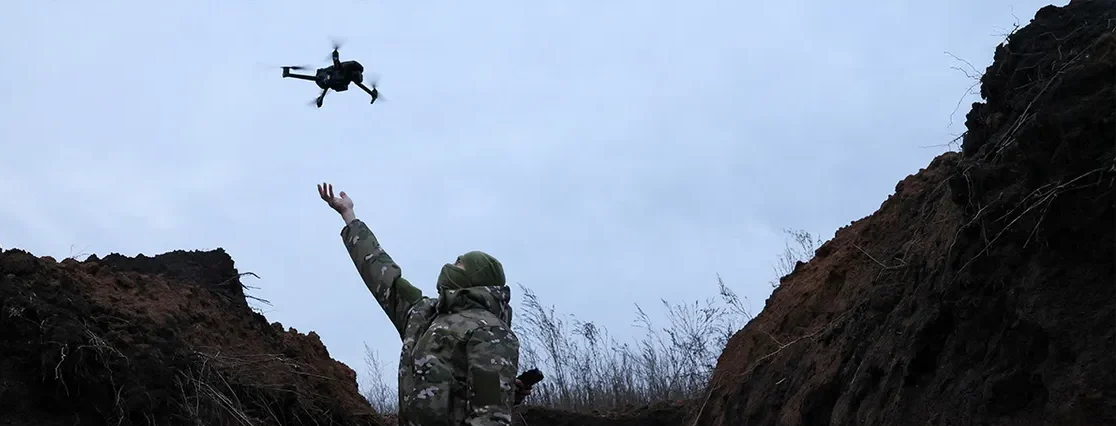
From Observation to Adaptation: New MW COE Report on Unmanned Systems in Mountain Warfare
The NATO Mountain Warfare Centre of Excellence is proud to announce the release of its latest study:
Unmanned Systems in Mountain Warfare – Assessing the Impact of Emerging Technologies on NATO Mountain Forces.
The report represents the culmination of several years of observation, experimentation, multinational workshops, and exchanges with military practitioners, industry representatives, and partner nations. Rather than focusing on individual technologies, the study examines the operational implications of unmanned systems and their growing impact on mountain warfare doctrine, forcestructures, training, and capability development.
The findings are clear: unmanned systems are no longer emerging technologies or niche capabilities. They have become a structural componentof the modern battlefield, fundamentally changing how forces observe, manoeuvre, sustain operations, and survive in contested environments. Persistent surveillance, electronic warfare, decentralized effects, and the increasing importance of Counter-UAS capabilities are already reshaping military operations in mountainous terrain.
The study highlights that the challenge facing military organizations is no longer how to introduce drones into existing structures, but rather how to adapt those structures to a battlefield in which unmanned systems are already central. It also explores new operational opportunities for mountain forces, including enhanced reconnaissance, distributed effects, sustainment through cargodrones, and improved environmental intelligence in snow- and ice-dominated environments.
This publication is intended not as a final answer, but as a contribution to an ongoing process of adaptation and institutional learning across the NATO Mountain Warfare Community of Interest. It aims to stimulate professional discussion and support future doctrinal and capability development efforts.
"Adaptation is no longer a matter of competitive advantage. It is becoming a prerequisite for
operational relevance."
Looking Ahead: 7th Mountain Warfare Congress
The release of this report marks only the beginning of a broader effort.The 7th Mountain Warfare Congress, hosted by the NATO MW COE in cooperation with the General Tadeusz Kościuszko Military University of Land Forces (AWL – Centre of Mountain Training), will take place from 26 to 29 October 2026 in Zakopane, Poland.
Set in the unique environment of the Polish Tatra Mountains, the Congress will bring together military leaders, operational planners, researchers, industry representatives, and subject-matter experts to examine current and emerging challenges in mountain warfare.
A central highlight of the event will be the presentation of a comprehensive study on the employment of Unmanned Aerial Systems in mountain operations and the discussion of newly developed and commonly agreed Tactics, Techniques and Procedures intended to support the future evolution of NATO doctrine, including ATP-3.2.1.3.
The Congress will also mark the official launch of the Mountain Warfare Drone Awareness Course, a new educational initiative developed by the NATO MW COE to increase understanding of drone-centric operations and their implications for mountain forces. The course will be delivered for the first time in 2027, representing another important step in preparing Allied and Partner nations for an operational environment increasingly shaped by unmanned and autonomous systems.
As mountain warfare enters a new era, adaptation, experimentation, and cooperation remain essential. The NATO MW COE invites the entire international mountain warfare community to join this discussion in Zakopane and contribute to shaping the future of operations in one of the world’s most demanding operational environments.
We warmly invite Subject Matter Experts from NATO nations and partners to participate in the 7th Mountain Warfare Congress - October 2026
For further information and registration, please click on the button!